Company Logo

SSC CGL Recruitment 2025 Exam is an excellent chance for turning your dreams into reality! Get detailed information about SSC CGL 2025 Exam Date, Salary, Syllabus, Preparation Guide, Admit Card, Latest Exam Pattern and Exam Results. Boost your preparation journey with the Online Test Series now!

SSC CGL 2026

SSC CGL Recruitment 2026-27: Notification

Hero shadow
Hero shadow

Introduction

Combined Graduate Level Examination, 2026-27 
SSC CGL 2026-27

Staff Selection Commission will hold Combined Graduate Level Examination, 2026-27 for filling up of various Group „B‟ and Group „C‟ posts in different Ministries/ Departments/ Organizations of Government of India and various Constitutional Bodies/Statutory Bodies/ Tribunals, etc. 

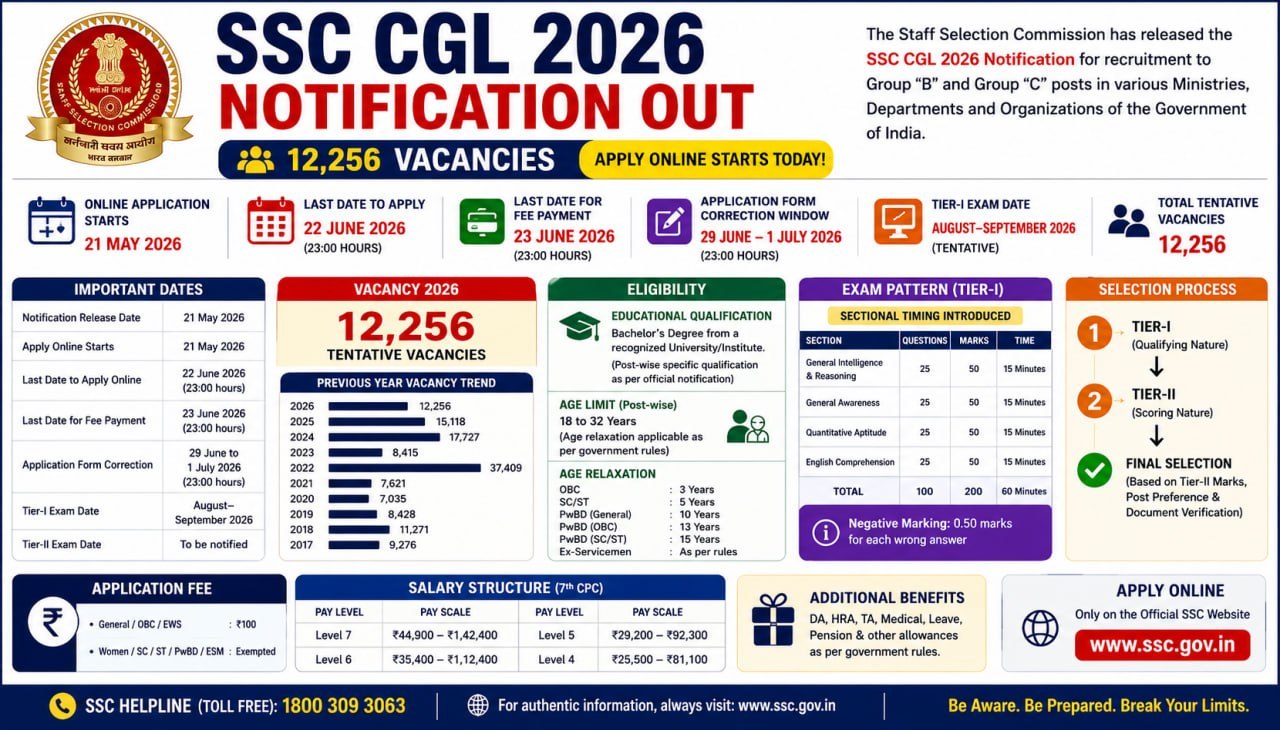
IMPORTANT DATES (Expected)

Event

Date 

Dates for Submission of Online Applications

March 2026 to April 2026

Last Date and Time for Receipt of Online Applications

April 2026

Last Date and Time for Online Fee Payment

April 2026

Application Form Correction Window (with online payment)

April 2026

Tentative Schedule of Tier-I (Computer Based Examination)

May – June 2026

Tentative Schedule of Tier-II (Computer Based Examination)

TO BE NOTIFIED SOON

Toll Free Helpline Number (For Application Assistance)

1800 309 3063 (Toll Free)


Exam Pattern

SSC CGL Exam Pattern 2026-27

 Structure of the Examination

The Computer-Based Examination (CBE) for SSC CGL 2026-27 will be conducted in two tiers:

  • Tier-I: Preliminary Examination
  • Tier-II: Main Examination

 Normalization of Marks (If Multiple Shifts are Conducted)

If the CBE is held in multiple shifts, the marks obtained by candidates will be normalized using a procedure published by the Commission. This normalization process will ensure that the scores are fair and consistent across all shifts. The normalized scores will be used to determine the final merit and cut-off marks for the exam.

Tentative Answer Keys and Representations

  • After the Computer-Based Examinations, the tentative answer keys will be published on the official website of the Commission.
  • Candidates can review these answer keys and submit online representations if they feel there is an error in any question. Representations must be submitted within the stipulated time limit and require a payment of ₹100/- per question (non-refundable).
  • Important Note: Representations submitted through other modes, such as letters, emails, or applications, will not be entertained.
  • All representations will be scrutinized before finalizing the answer keys. The final decision of the Commission regarding the answer keys will be final.
  • Once the final answer keys are determined, they will be used for processing the results of the Computer-Based Examination and will be uploaded on the website of the Commission after the results are declared.

 Tentative Examination Schedule

  • The schedule of examinations mentioned in the notice is tentative.
  • Any changes to the exam schedule or other relevant information will only be communicated through the official website of the Commission. Candidates are advised to regularly check the website for updates.

 Use of Metric System in the Question Papers

  • The Metric System of Weights and Measures will be used in the question papers, wherever necessary. Candidates should be familiar with these units for better understanding and calculation.

 No Re-Evaluation/Re-Checking of Scores

  • No re-evaluation or re-checking of the scores will be allowed for any stage of the examination.
  • Candidates are advised to carefully review their answers before submitting, as no correspondence regarding the re-evaluation of scores will be entertained.

SSC CGL Tier-1 Exam Pattern 2026-27

SSC CGL Tier 1 Exam Pattern

S.No.

Sections

No. of Questions

Total Marks

Time Allotted

1

General Intelligence and Reasoning

25

50

Cumulative Time – 60 minutes

2

General Awareness

25

50

3

Quantitative Aptitude

25

50

4

English Comprehension

25

50

Total

100

200

Tier-I will consist of Objective Type, Multiple choice questions. The questions will be set both in English & Hindi except for English Comprehension.

Penalty of Wrong Answer:-

There will be negative marking of 0.50 marks for each wrong answer. 


SSC CGL Tier-2 Exam Pattern 2026-27


Paper

Session

Subject

Number of Questions

Maximum Marks

Time Allowed

Paper-I

Session-I

Section-I:


(2 hours and 15 minutes)

A: Mathematical Abilities

30

60×3 = 180

1 hour (For each section)


B: Reasoning and General Intelligence

30


(1 hour and 20 minutes for scribe-eligible candidates as per Para 7.1, 7.2, 7.3)


Total = 60


Section-II:


A: English Language and Comprehension

45

70×3 = 210


B: General Awareness

25


Total = 70


Section-III: Computer Knowledge Test

20

20×3 = 60

15 minutes (for Section-III & IV each)


Session-II (15 mins)

Section-IV: Data Entry Speed Test

One Data Entry Task

15 minutes

Paper-II

Statistics

100

100×2 = 200

2 hours (2 hrs 40 mins for scribe-eligible candidates)

Conducting Paper-I and Paper-II

  • Tier-II will consist of two papers, Paper-I and Paper-II, which will be held in separate shifts or on different days.

 Paper-I (Compulsory for All Candidates)

  • Paper-I is compulsory for all candidates appearing in Tier-II.
  • The paper will cover the following sections:
    • Section-I:
      • A: Mathematical Abilities
      • B: Reasoning and General Intelligence
    • Section-II:
      • A: English Language and Comprehension
      • B: General Awareness
    • Section-III: Computer Knowledge Test
    • Section-IV: Data Entry Speed Test (DEST)

 Paper-II (Specific to Certain Posts)

  • Paper-II will only be for candidates who are applying for the posts of Junior Statistical Officer (JSO) in the Ministry of Statistics and Programme Implementation or Statistical Investigator Grade-II in the office of the Registrar General of India (M/o Home Affairs), and who have been shortlisted after Tier-I.

 Detailed Breakdown of Paper-I

  • Paper-I will be conducted in two sessions on the same day:
    • Session-I will include Sections III, and III, and will last for 2 hours and 15 minutes.
    • Session-II will include Section-IV, the Data Entry Speed Test (DEST), and will last for only 15 minutes.

 Session-I (Paper-I)

  • Section-I:
    • Duration: 1 hour for both Mathematical Abilities (Part A) and Reasoning and General Intelligence (Part B).
    • After 1 hour, the section will automatically close.
  • Section-II:
    • Duration: 1 hour for English Language and Comprehension and General Awareness.
    • After 1 hour, this section will automatically close.
  • Section-III:
    • Duration: 15 minutes for the Computer Knowledge Test.
  • After Session-I is completed, candidates will get a break before Session-II.

 Session-II (Paper-I)

  • Section-IV:
    • Duration: 15 minutes for the Data Entry Speed Test (DEST).

Mandatory Qualification for Paper-I

  • It is mandatory for candidates to qualify in all sections of Paper-I separately.

 Exam Type and Negative Marking

  • Tier-II (Paper-I & Paper-II) will consist of Objective Type, Multiple-Choice Questions.
    • Section-IV (DEST) will be an exception, being a skill test.
  • Negative Marking:
    • 1 mark will be deducted for every incorrect answer in Section-I, Section-II, and Section-III of Paper-I.
    • 0.50 marks will be deducted for every incorrect answer in Paper-II.

 Computer Knowledge Test (Section-III)

  • The Computer Knowledge Test (Section-III) is mandatory but qualifying in nature.
  • For posts requiring Computer Proficiency (e.g., Assistant Section Officer, Assistant in various Ministries), higher qualifying standards will be set compared to other posts.

 Data Entry Speed Test (DEST)

  • Section-IV of Paper-I will include the Data Entry Speed Test for a duration of 15 minutes.
    • DEST Skill Test involves typing approximately 2000 key depressions in 15 minutes.
  • Exemption for PwBD (Orthopedic Handicapped) Candidates:
    • PwBD candidates (who provide a valid medical certificate from the competent medical authority) are exempted from DEST if they are permanently unfit due to physical disability.
    • However, this exemption is not applicable for posts requiring Computer Proficiency or DEST (except for Tax Assistant in CBDT).
  • Compensatory Time:
    • PwBD candidates eligible for scribes will be given additional compensatory time of 5 minutes for DEST.

Key Highlights for Candidates

  • Paper-I is compulsory for all candidates, whereas Paper-II is only for specific posts (JSO and Statistical Investigator).
  • Candidates must qualify all sections of Paper-I separately.
  • Negative marking is applicable in both Paper-I and Paper-II.
  • The DEST is mandatory for posts requiring Data Entry and is qualifying in nature.
  • PwBD candidates may be exempt from DEST under specific conditions.

How To Apply

How to Apply for SSC CGL 2026-27

 Step-by-Step Guide

 Submission of Application

  • Applications for SSC CGL 2026-27 must be submitted online via the SSC Headquarters websitehttps://ssc.gov.in.
  • You can also apply through the mySSC mobile application, which is available for download from the Google Play Store.
  • For detailed instructions, refer to Annexure-III and Annexure-IV of the official notice
  • Sample proformas for One-Time Registration and Online Application Forms are attached as Annexure-IIIA and Annexure-IVA.

One-Time Registration (OTR)

  • Candidates who have not yet generated their One-Time Registration (OTR) on the new SSC website will need to do so.
  • OTR on the old SSC website (ssc.nic.in) will not be valid on the new website.
  • After completing the OTR, candidates can proceed to fill the online application form.
  • The OTR will remain valid for all future exams applied for on the new website.
  • Detailed instructions for OTR are available in Annexure-III.

Aadhaar-Based Authentication

  • Candidates are advised to opt for Aadhaar-based authentication during the OTR process. This step follows the Aadhaar Policy as per the guidelines published on the SSC website.
  • Benefits of Aadhaar Authentication:
    • Your application will not be rejected due to issues with your photograph or signature.
    • Candidates opting for Aadhaar Authentication will not be required to produce a recent colour photograph or original valid photo-identity proof when attending the Computer Based Examination.

Photograph Requirements

  • While applying, candidates are not required to have a pre-existing photograph.
  • The application module will capture a photograph of the candidate as part of the application process. Here’s how to capture your photograph correctly:
    1. Choose a location with good lighting and a plain background.
    2. Ensure the camera is positioned at eye level.
    3. Sit or stand directly in front of the camera, looking straight ahead.
    4. Ensure the face is fully within the designated area and not too close or too far.
    5. Do not wear a cap, mask, or glasses/spectacles while taking the photograph.

Photograph Consistency

  • The appearance of the candidate in the examination should match the photograph uploaded in the application form.
  • Applications with photographs that do not comply with the guidelines (e.g., wearing glasses, caps, or masks) will be rejected.
  • Note: Applications submitted via Aadhaar-based authentication will not be rejected on these grounds.

Signature Requirements

  • Upload a scanned signature in JPEG/JPG format (10 to 20 KB) with dimensions of approximately 6.0 cm (width) x 2.0 cm (height).
  • Applications with inappropriate photographs or blurred/minute signatures will be rejected unless submitted through Aadhaar-based authentication.

PwBD/PwD Candidates

  • Candidates seeking reservation or scribe benefits, or both, must upload a Certificate of Disability as per Annexure-IAnnexure-IA, and Annexure-XII to XIV, depending on the applicable category.

Important Dates

  • Candidates are strongly advised to submit their applications well before the last date to avoid issues related to website traffic or connectivity problems.

Submission Deadline

  • The Commission will not be responsible for candidates who cannot submit their applications due to reasons beyond its control, including issues related to website traffic.

Review and Submit Application

  • Before submitting your online application, ensure that:
    • All details in the form are filled out correctly.
    • The photograph and signature meet the required standards.
  • Use the Preview/Print option to verify all the information before submission.
  • Keep a copy of the application for your records.

Syllabus

SSC CGL Syllabus Tier-I 2026-27

General Intelligence and Reasoning: This section would include questions of both verbal and non-verbal type. This component may include questions on analogies, similarities and differences, space visualization, spatial orientation, problem solving, analysis, judgment, decision making, visual memory, discrimination, observation, relationship concepts, arithmetical reasoning and figural classification, arithmetic number series, non-verbal series, coding and decoding, statement conclusion, syllogistic reasoning etc. The topics are, Semantic Analogy, Symbolic/ Number Analogy, Figural Analogy, Semantic Classification, Symbolic/ Number Classification, Figural Classification, Semantic Series, Number Series, Figural Series, Problem Solving, Word Building, Coding & de-coding, Numerical Operations, symbolic Operations, Trends, Space Orientation, Space Visualization, Venn Diagrams, Drawing inferences, Punched hole/ pattern- folding & un-folding, Figural Pattern- folding and completion, Indexing, Address matching, Date & city matching, Classification of centre codes/roll numbers, Small & Capital letters/ numbers
coding, decoding and classification, Embedded Figures, Critical thinking, Emotional Intelligence, Social Intelligence, Other sub-topics, if any.

General Awareness: Questions in this component will be aimed at testing the candidate’s general awareness of the environment around him and its application to society. Questions will also be designed to test knowledge of current events and of such matters of everyday observations and experience in their scientific aspect as may be expected of any educated person. The test will also include questions relating to India and its neighbouring countries especially pertaining History, Culture, Geography, Economic Scene, General Policy & Scientific Research.

Quantitative Aptitude: The questions will be designed to test the ability of appropriate use of numbers and number sense of the candidate. The scope of the test will be computation of whole numbers, decimals, fractions and relationships between numbers, Percentage. Ratio & Proportion, Square roots, Averages, Interest, Profit and Loss, Discount, Partnership Business, Mixture and Alligation, Time and distance, Time & Work, Basic algebraic identities of School Algebra & Elementary surds, Graphs of Linear Equations, Triangle and its various kinds of centres, Congruence and similarity of triangles, Circle and its chords, tangents, angles subtended by chords of a circle, common tangents to two or more circles, Triangle, Quadrilaterals, Regular Polygons, Circle, Right Prism, Right Circular Cone, Right Circular Cylinder, Sphere, Hemispheres, Rectangular Parallelepiped, Regular Right Pyramid with triangular or square base, Trigonometric ratio, Degree and Radian Measures, Standard Identities, Complementary angles, Heights and Distances, Histogram, Frequency polygon, Bar diagram & Pie chart.

English Comprehension: Candidate’s ability to understand correct English, his/ her basic comprehension and writing ability, etc. would be tested.

Note: The questions in Parts A, B, & D will be of a level commensurate with the essential qualification viz. Graduation and questions in Part-C will be of 10th standard level.

SSC CGL Syllabus for Tier II 2026-27


Part A of Section-I of Paper-I (Mathematical Abilities):

 Number Systems: Computation of Whole Number, Decimal and Fractions, Relationship between numbers.

 Fundamental arithmetical operations: Percentages, Ratio and Proportion, Square roots, Averages, Interest (Simple and Compound), Profit and Loss, Discount, Partnership Business, Mixture and Alligation, Time and distance, Time and work.

 Algebra: Basic algebraic identities of School Algebra and Elementary surds (simple problems) and Graphs of Linear Equations.

 Geometry: Familiarity with elementary geometric figures and facts: Triangle and its various kinds of centres, Congruence and similarity of triangles, Circle and its chords, tangents, angles subtended by chords of a circle, common tangents to two or more circles.

 Mensuration: Triangle, Quadrilaterals, Regular Polygons, Circle, Right Prism, Right Circular Cone, Right Circular Cylinder, Sphere, Hemispheres, Rectangular Parallelepiped, Regular Right Pyramid with triangular or square Base.

 Trigonometry: Trigonometry, Trigonometric ratios, Complementary angles, Height and distances (simple problems only) Standard Identities

 Statistics and probability: Use of Tables and Graphs: Histogram, Frequency polygon, Bar-diagram, Pie-chart; Measures of central tendency: mean, median, mode, standard deviation; calculation of simple probabilities.

 Part B of Section-I of Paper-I (Reasoning and General Intelligence):

 Questions of both verbal and non-verbal type. These will include questions on Semantic Analogy, Symbolic operations, Symbolic/ Number Analogy, Trends, Figural Analogy, Space Orientation, Semantic Classification, Venn Diagrams, Symbolic/ Number Classification, Drawing inferences, Figural Classification, Punched hole/ pattern-folding & unfolding, Semantic Series, Figural Patternfolding and completion, Number Series, Embedded figures, Figural Series, Critical Thinking, Problem Solving, Emotional Intelligence, Word Building, Social Intelligence, Coding and de-coding, Numerical operations, Other sub-topics, if any.

 Part A of Section-II of Paper-I (English Language And Comprehension):

 Vocabulary, grammar, sentence structure, synonyms, antonyms and their correct usage; Spot the Error, Fill in the Blanks, Synonyms/ Homonyms, Antonyms, Spellings/ Detecting mis-spelt words, Idioms & Phrases, One word substitution, Improvement of Sentences, Active/ Passive Voice of Verbs, Conversion into Direct/ Indirect narration, Shuffling of Sentence parts, Shuffling of Sentences in a passage, Cloze Passage, Comprehension Passage. To test comprehension, three or more paragraphs will be given and questions based on those will be asked. At least one paragraph should be a simple one based on a book or a story and the other two paragraphs should be on current affairs, based on a report or an editorial.

 Part B of Section-II of Paper-I (General Awareness):

 Questions are designed to test the candidates’ general awareness of the environment around them and its application to society. Questions are also designed to test knowledge of current events and of such matters of everyday observation and experience in their scientific aspect as may be expected of an educated person. The test will also include questions relating to India and its neighboring countries especially pertaining to History, Culture, Geography, Economic Scene, General policy and scientific research.

 Section-III of Paper-I (Computer Proficiency):

 Computer Basics: Organization of a computer, Central Processing Unit (CPU), input/ output devices, computer memory, memory organization, back- up devices, PORTs, Windows Explorer. Keyboard shortcuts.

 Software: Windows Operating system including basics of Microsoft Office like MS word, MS Excel and Power Point etc..

 Working with Internet and e-mails: Web Browsing & Searching, Downloading & Uploading, Managing an E-mail Account, e-Banking.

 Basics of networking and cyber security: Networking devices and protocols, Network and information security threats (like hacking, virus, worms, Trojan etc.) and preventive measures.

 Paper-II (Statistics):

 Collection, Classification and Presentation of Statistical Data – Primary and Secondary data, Methods of data collection; Tabulation of data; Graphs and charts; Frequency distributions; Diagrammatic presentation of frequency distributions.

 Measures of Central Tendency- Common measures of central tendency – mean median and mode; Partition values- quartiles, deciles, percentiles.

 Measures of Dispersion- Common measures dispersion – range, quartile deviations, mean deviation and standard deviation, Measures of relative dispersion.

 Moments, Skewness and Kurtosis- Different types of moments and their relationship; meaning of skewness and kurtosis; different measures of skewness and kurtosis. .

 Correlation and Regression- Scatter diagram; simple correlationcoefficient; simple regression lines; Spearman’s rank correlation; Measures of association of attributes; Multiple regression; Multiple and partial correlation (For three variables only). . Probability Theory- Meaning of probability; Different definitions of probability; Conditional probability; Compound probability; Independent events; Bayes theorem. .

 Random Variable and Probability Distributions- Random variable; Probability functions; Expectation and Variance of a random variable; Higher moments of a random variable; Binomial, Poisson, Normal and Exponential distributions; Joint distribution of two random variable (discrete). .

 Sampling Theory- Concept of population and sample; Parameter and statistic, Sampling and non-sampling errors; Probability and nonprobability sampling techniques (simple random sampling, stratified sampling, multistage sampling, multiphase sampling, cluster sampling, systematic sampling, purposive sampling, convenience sampling and quota sampling); Sampling distribution(statement only); Sample size decisions. .

 Statistical Inference- Point estimation and interval estimation, Properties of a good estimator, Methods of estimation (Moments method, Maximum likelihood method, Least squares method), Testing of hypothesis, Basic concept of testing, Small sample and large sample tests, Tests based on Z, t, Chi-square and F statistic, Confidence intervals. .

 Analysis of Variance- Analysis of one-way classified data and two-way classified data. .

 Time Series Analysis- Components of time series, Determinations of trend component by different methods, Measurement of seasonal variation by different methods. .

Index Numbers- Meaning of Index Numbers, Problems in the construction of index numbers, Types of index number, Different formulae, Base shifting and splicing of index numbers, Cost of living Index Numbers, Uses of Index Numbers. .Questions in Part A of Section- I of Paper-I (Mathematical Abilities) will be of Matriculation Level, in Part A of Section- II of Paper-I (English Language and Comprehension) of 10+2 Level and in Paper-II of Graduation Level. 

Cut Off

SSC CGL Tier-I Exam Cut-Off for 2025

Declaration of Result of Combined Graduate Level Examination (Tier-I), 2025.

Staff Selection Commission had conducted Combined Graduate Level Examination (Tier-I), 2025 during the period from 12.09.2025 to 26.09.2025 and on 14.10.2025 (Re-examination) in the Computer Based Mode.

2. Based on the marks scored in CGL(Tier-I) Examination, the candidates (category-wise) have been shortlisted to appear in Tier-II examination. Separate cut-offs marks have been fixed for the posts of Junior Statistical Officer (JSO) (List-1), Statistical Investigator (SI) Grade-II (List-2) and All posts Other than JSO and SI Grade-II (List-3).

3. Since the Tier-I of Computer Based Examination was conducted in multiple shift, the marks scored by the candidates have been normalized in accordance with formulae/methodology published by the Commission (through the Write-up F. No. HQ-PP001/6/2024-PP dated 02.06.2025) on its website. Such normalized marks have been used to qualify the candidates for the next stage of Examination [i.e. CGLE (Tier-II)].

4. In terms of Para-16.1 of Notice of the Examination, the following minimum marks have been fixed for qualifying in the CGLE(Tier-I):- (a) UR : 30% (b) OBC / EWS : 25% (c) All Other Categories : 20%

5. The category-wise cut-off marks and the number of candidates shortlisted for appearing in the CGL (Tier-II) Examination are as follows:
List-1: Candidates shortlisted in CGLE (Tier-I) for appearing in Tier-II [Paper-I & Paper-II (Statistics)] (for the post of Junior Statistical Officer):

Category

Cut-off Marks

Number of candidates available

SC

137.29518

1509

ST

136.40211

473

OBC

153.46108

1494#

EWS

151.58638

934

UR

153.46108

1449*

OH

125.16130

111

HH

104.04315

92

VH

134.15850

44

Others (PwD)

91.01367

90

Total


6196

# Including 01 ESM category candidate qualifying at cut-off marks of OBC category.

* In addition to the UR candidates shown above, a total 99-SC, 22-ST, 1467-OBC, 685-EWS and 03-PwD(OH) candidates qualifying at UR Standards (both prescribed Cut-off marks and Age-limit) have been shown under their respective categories.

Note-1: Only those candidates have been considered eligible for inclusion in List-1 who have applied for the post of JSO in their online Application Forms.

List-2: Candidates shortlisted in CGLE (Tier-I) for appearing in Tier-II [Paper-I & Paper-II (Statistics)] (for the post of Statistical Investigator Grade-II)

Category

Cut-off Marks

Number of Candidates available

SC

137.16184

577#

ST

130.16987

377$

OBC

150.51402

892

EWS

152.14666

350

UR

152.47231

525*

HH

112.62423

30

OH

127.48052

30

Total


2781

# Including 01-PwD(VH) category candidate qualifying at cut-off marks of SC category.

$ Including 01-PwD(Others) category candidate qualifying at cut-off marks of ST category.

* In addition to the UR candidates shown above, a total of 36-SC, 16-ST, 606-OBC, 329-EWS and 01-PwD(OH) candidates qualifying at UR Standards (both prescribed Cut-off marks and Age- limit) have been shown under their respective categories.

Note-2: Only those candidates have been considered eligible for List-2 who have applied for the post of Statistical Investigator Grade-II in their online Application Forms.

List-3: Candidates shortlisted in CGLE (Tier-I) for appearing in Tier-II (Paper-I)(for all posts Other than JSO and Statistical Investigator Grade-II)

Category

Cut-off Marks

Number of Candidates available

SC

114.97063

25338

ST

106.36936

11729

OBC

130.36617

43260

EWS

127.41630

20268

UR

136.83159

20035*

ESM

92.80460

3511

OH

100.87394

1667

HH

68.79973

1550$

VH

72.00006

1615#

Others (PwD)

41.70541

1445^

Total


130418

$ Including 10-ESM category candidates qualifying at cut-off marks of PwD(HH) category.

# Including 04-ESM category candidates qualifying at cut-off marks of PwD(VH) category. ^ Including 33-ESM category candidates qualifying at cut-off marks of PwD(Others) category.

* In addition to the UR candidates shown above, a total of 3561-SC, 855-ST, 24404-OBC, 10568-EWS, 38-ESM, 103-OH, 11-HH, 75-VH and 07-PwD(Others) candidates qualifying at UR Standards (both prescribed Cut-off marks and Age- limit) have been shown under their respective categories.

SSC CGL 2025 Tier 2 Exam Date Out

The Tier-II Stage of Combined Graduate Level Examination, 2025 is tentatively scheduled to be held during 03rd Week of January, 2026. The shortlisted candidates are hereby advised to visit the website of the Commission regularly for further relevant updates.

The Representations received from the candidates against the Tentative Answer Key(s) of CGL(Tier-I) Examination have been carefully examined and the Answer Key(s) have been modified wherever necessary. The Final Answer Keys have been used for evaluation purposes. The Final Answer Keys along-with Question Papers and Marks of the qualified/non-qualified candidates will be hosted / published on the website of the Commission in due course.


SSC CGL Tier-I Exam Cut-Off for 2024

List-1: Candidates shortlisted in Tier-I for appearing in Tier-II [Paper-I and Paper-III General Studies (Finance & Economics} (for the post of
Assistant Audit Officer and Assistant Accounts Officer) are mentioned below:

List 3: SSC CGL Tier 1 Cut-Off for posts other than JSO and Statistical Investigator Gr. II

Category

Revised cut-off

Candidates Qualified

Additional Candidates Qualified

SC

126.42

31131

49

ST

111.85

16019

25

OBC

146.23

50191

115

EWS

 141.82

23746

275

UR

152.97

23746

145

ESM

69.92

11133

--

OH

113.10

2093

--

HH

64.79

2042

--

VH

102.97

1694

--

Other-PwD

45.74

1377

--

Total

165240

609

List 1-Candidates shortlisted in Tier 1 for appearing in Tier 2 [Paper-I and II (Statistics)] (for the post of Junior Statistical Officer)

SSC CGL Cut Off for Junior Statistical Officer (JSO) Post

Category

SSC CGL JSO Cut-Off

Candidates Qualified

SC

143.53

3640

ST

135.23

1935

OBC

160.65

6839

EWS

161.73

2504

UR

167.02

2844

OH

133.35

217

HH

95.45

210

VH

122.51

247

Total Candidates

18436


SSC CGL Cut Off for Junior Statistical Officer (JSO) Post

Category

SSC CGL JSO Cut-Off

Candidates Qualified

SC

143.53

3640

ST

135.23

1935

OBC

160.65

6839

EWS

161.73

2504

UR

167.02

2844

OH

133.35

217

HH

95.45

210

VH

122.51

247

Total Candidates

18436

List 2-Candidates shortlisted in Tier 1 for appearing in Tier 2 [Statistical Investigator Gr. II]

SSC CGL Tier 1 Cut-Off for the post of Statistical Investigator Gr. II

Category

SSC CGL Statistical Investigator Gr.II Cut-Off

Candidates Qualified

ST

134.49

485

OBC

161.13

1106

EWS

163.50

352

UR

170.65

276

HH

60.66

213

VH

92.05

181

Others PWD

40.30

220

Total

2833

SSC CGL Tier 2 Cut Off 2024

Staff Selection Commission (SSC) released the SSC CGL Tier 2 cut-off marks for all posts on 13th March 2025 along with the final SSC CGL 2024 Result. The SSC CGL Tier 2 exam was conducted 18th, 19th, and 20th January 2025. The Commission has announced the SSC CGL Cut Off 2024 category-wise separately for Statistics & Junior Statistical Officer (JSO), Statistical Investigator Gr.II, Finance/ and other posts. Now, you can check the SSC CGL Tier 2 cut-off Post Wise and category-wise.

SSC CGL Tier 2 Cut Off 2024 [all posts except SI Gr. II]

Category

Cut-off Marks

Candidates Available

SC

285.45888

15,875

ST

266.49513

8,295

OBC

306.27841

28,628

EWS

300.03797

14,575

UR

322.77352

11,631

ESM

202.28472

5,497

OH

258.66022

1,043

HH

181.89266

1,011

VH

219.45053

810

PwD-Other

136.73346

686

Total

-

88,051


Post Code - Department

UR

EWS

OBC

SC

ST

HH

VH

OH

Others

ESM

B03 - Assistant/ASO - CSS

533.2468

349.4802

348.5815

337.2330

330.8955

295.4264

273.8796

331.8675

287.1774

-

B05 - Assistant/ASO - IB

353.9384

349.4851

350.5067

337.0752

307.0732

-

-

-

-

-

B06 - Assistant/ASO - Railways

362.0740

359.5187

359.4567

346.1172

312.9926

317.7746

-

-

311.4663

-

B07 - Assistant/ASO - Election Commission

354.0591

354.0517

354.0591

345.1089

-

-

336.3938

-

-

-

B09 - Assistant/ASO - AFHQ

360.9569

359.6959

358.9758

351.5660

349.4452

-

-

-

-

-

B11 - Assistant/ASO - External Affairs

360.6925

358.9065

358.2172

351.6593

349.3827

-

-

-

-

-

B13 - Assistant/ASO - MCA

350.8120

348.2588

353.6566

343.8724

324.9754

296.4954

319.5501

328.8937

302.8324

-

B18 - Inspector (Preventive Officer) - CBIC

348.9974

344.4342

344.0487

343.4766

336.0113

328.8753

-

-

-

-

B20 - Inspector (Examiner) - CBIC

349.8495

344.4342

344.0487

343.4766

336.0113

328.8753

-

-

-

-

C02 - Junior Statistical Officer

438.6747

412.4411

411.6871

378.8725

372.3687

211.3736

224.0324

217.9174

322.1428

-

C03 - Statistical Investigator Grade-II

438.6747

412.4411

411.6871

378.8725

372.3687

211.3736

224.0324

217.9174

322.1428

-

D05 - Accountant/Junior Accountant - CAG

344.2433

340.8978

340.6102

324.3792

319.8663

287.0812

311.2863

-

287.9182

-

D09 - UDC/SSA - MSME

340.0983

340.3919

340.8978

324.3792

319.8663

287.0812

311.2863

-

287.9182

-

D17 - Sub-Inspector (NCB)

338.2326

337.3047

337.5042

326.8715

261.7351

261.1682

-

-

309.6970


Vacancies

Vacancy 2026-27

TO BE NOTIFIED SOON

Vacancy 2025

Tentative vacancies

There are approx. 14582 vacancies. However, final vacancies will be determined in due course. Updated vacancies, if any, along with post wise & category-wise vacancies will be made available on the website of the Commission 
(https://ssc.gov.in> For Candidates > Tentative Vacancy). Candidates may note that State-wise/ Zone-wise vacancies are not collected by the Commission. Candidates are advised to approach the concerned User Departments for information pertaining to zone-wise/state-wise vacancies.  

Before applying for the SSC CGL 2025, candidates should look at the vacancy trends in the following table.

Years

UR

SC

ST

OBC

Total Vacancy

2024

7,567

2,762

1,606 

4,521

18,174 

2023

3829

1273

618

1900

8415

2022

15408

5572

2889

8341

36012

2021

3024

1204

703

897

7621

2020

2891

1046

510

1858

7035


Salary

Details of the Posts: 

Following are the likely posts that will be filled up through this  Examination: 

SSC Posts under Pay Level-7 (₹ 44,900 – ₹ 1,42,400)

S. No.

Name of Post

Ministry/Department/Office

Classification

1

Assistant Section Officer

Central Secretariat Service

Group “B”

2

Assistant Section Officer

Intelligence Bureau

Group “B”

3

Assistant Section Officer

Ministry of Railways

Group “B”

4

Assistant Section Officer

Ministry of External Affairs

Group “B”

5

Assistant Section Officer

AFHQ

Group “B”

6

Assistant Section Officer

Ministry of Electronics and Information Technology

Group “B”

7

Assistant / Assistant Section Officer

Other Ministries/Departments/Organizations

Group “B”

8

Inspector of Income Tax

CBDT

Group “C”

9

Inspector (Central Excise)

CBIC

Group “B”

10

Inspector (Preventive Officer)

CBIC

Group “B”

11

Inspector (Examiner)

CBIC

Group “B”

12

Assistant Enforcement Officer

Directorate of Enforcement, Dept. of Revenue

Group “B”

13

Sub Inspector

Central Bureau of Investigation (CBI)

Group “B”

14

Inspector Posts

Department of Posts, Ministry of Communications

Group “B”

15

Inspector

Central Bureau of Narcotics, Ministry of Finance

Group “B”

16

Section Head

Directorate General of Foreign Trade

Group “B”

SSC Posts under Pay Level-6 (₹ 35,400 – ₹ 1,12,400)

S. No.

Post Name

Ministry / Department / Office

Post Type

17

Assistant / Assistant Section Officer

Other Ministries / Departments / Organizations

Group “B”

18

Executive Assistant

Central Board of Indirect Taxes and Customs (CBIC)

Group “B”

19

Research Assistant

National Human Rights Commission (NHRC)

Group “B”

20

Divisional Accountant

Offices under Comptroller and Auditor General (C&AG)

Group “B”

21

Sub-Inspector

National Investigation Agency (NIA)

Group “B”

22

Sub-Inspector / Junior Intelligence Officer

Narcotics Control Bureau (Ministry of Home Affairs)

Group “B”

23

Junior Statistical Officer

Ministry of Statistics & Programme Implementation

Group “B”

24

Statistical Investigator Grade-II

Ministry of Home Affairs

Group “B”

25

Office Superintendent

Central Board of Direct Taxes (CBDT)

Group “B”

SSC Posts under Pay Level-5 (₹ 29,200 – ₹ 92,300)

S. No.

Post Name

Ministry / Department / Office

Post Type

26

Auditor

Offices under (C&AG)

Group “C”

27

Auditor

Offices under  (CGDA)

Group “C”

28

Auditor

Other Ministries / Departments

Group “C”

29

Accountant

Offices under  (C&AG)

Group “C”

30

Accountant

Controller General of Accounts

Group “C”

31

Accountant / Junior Accountant

Other Ministries / Departments

Group “C”

SSC Posts under Pay Level-4 (₹ 25,500 – ₹ 81,100)

S. No.

Post Name

Ministry / Department / Office

Post Type

32

Postal Assistant / Sorting Assistant

Department of Posts, Ministry of Communications

Group “C”

33

Senior Secretariat Assistant / UDC

Central Govt. Offices / Ministries (other than CSCS cadres)

Group “C”

34

Senior Administrative Assistant

Military Engineering Services, Ministry of Defence

Group “C”

35

Tax Assistant

Central Board of Direct Taxes (CBDT)

Group “C”

36

Tax Assistant

Central Board of Indirect Taxes and Customs (CBIC)

Group “C”

37

Sub-Inspector

Central Bureau of Narcotics, Ministry of Finance

Group “C”


Eligibility Criteria

SSC CGL Eligibility Criteria 2026-27

Nationality/Citizenship

A candidate must be either:

  • a citizen of India, or
  • a subject of Nepal, or
  • a subject of Bhutan, or
  • a person of Indian origin who has migrated from Pakistan, Burma, Sri Lanka, East African Countries of Kenya, Uganda, the United Republic of Tanzania (Formerly Tanganyika and Zanzibar), Zambia, Malawi, Zaire, Ethiopia and Vietnam with the intention of permanently settling in India.

Note: The official notification reads, "A candidate in whose case a certificate of eligibility is necessary may be admitted to the examination but the offer of appointment will be given only after the eligibility certificate has been issued to him by the Government of India."

 Age limit (As on 01-08-2026):  

               Requirement of age for various posts is as follows: 

S No

Age Limit

Remarks

(i)

For the posts for which age limit is 18–27 years

Candidate must have been born not earlier than 02-08-1998 and not later than 01-08-2007.

(ii)

For the posts for which age limit is 20–30 years

Candidate must have been born not earlier than 02-08-1995 and not later than 01-08-2005.

(iii)

For the posts for which age limit is 18–30 years

Candidate must have been born not earlier than 02-08-1995 and not later than 01-08-2007.

(iv)

For the posts for which age limit is 18–32 years

Candidate must have been born not earlier than 02-08-1993 and not later than 01-08-2007.

Permissible relaxation in upper age limit and category-codes for claiming age  relaxation are as follows: 

Code No

Category

Age-relaxation permissible beyond upper age limit

01

SC/ST

5 years

02

OBC

3 years

03

PwBD (Unreserved)

10 years

04

PwBD (OBC)

13 years

05

PwBD (SC/ST)

15 years

06

Ex-Servicemen (ESM)

3 years after deduction of the military service rendered from the actual age as on 01.08.2025

08

Defence Personnel disabled in operation during hostilities with any foreign country or in a disturbed area and released as a consequence thereof

3 years

09

Defence Personnel disabled in operation during hostilities with any foreign country or in a disturbed area and released as a consequence thereof (SC/ST)

8 years

Additional Permissible Relaxation in Upper Age Limit for Group 'C' Posts

Code No

Category

Age-relaxation permissible beyond upper age limit

10

Central Govt. Civilian Employees who have rendered not less than 3 years regular and continuous service as on closing date for receipt of application

Up to 40 years of age

11

Central Govt. Civilian Employees (SC/ST) who have rendered not less than 3 years regular and continuous service as on closing date for receipt of application

Up to 45 years of age

12

Widows/ Divorced Women/ Women judicially separated and who are not remarried

Up to 35 years of age

13

Widows/ Divorced Women/ Women judicially separated and who are not remarried (SC/ST)

Up to 40 years of age


S. No.

Name of Post

Ministry/Department/Office

Classification

Age Limit

1

Assistant Section Officer

Central Secretariat Service

Group “B”

20–30 years

2

Assistant Section Officer

Intelligence Bureau

Group “B”

18–30 years

3

Assistant Section Officer

Ministry of Railways

Group “B”

20–30 years

4

Assistant Section Officer

Ministry of External Affairs

Group “B”

20–30 years

5

Assistant Section Officer

AFHQ

Group “B”

20–30 years

6

Assistant Section Officer

Ministry of Electronics and Information Technology

Group “B”

18–30 years

7

Assistant / Assistant Section Officer

Other Ministries/Departments/Organizations

Group “B”

18–30 years

8

Inspector of Income Tax

CBDT

Group “C”

18–30 years

9

Inspector (Central Excise)

CBIC

Group “B”

18–30 years

10

Inspector (Preventive Officer)

CBIC

Group “B”

18–30 years

11

Inspector (Examiner)

CBIC

Group “B”

18–30 years

12

Assistant Enforcement Officer

Directorate of Enforcement, Dept. of Revenue

Group “B”

18–30 years

13

Sub Inspector

Central Bureau of Investigation (CBI)

Group “B”

20–30 years

14

Inspector Posts

Department of Posts, Ministry of Communications

Group “B”

18–30 years

15

Inspector

Central Bureau of Narcotics, Ministry of Finance

Group “B”

18–30 years

16

Section Head

Directorate General of Foreign Trade

Group “B”

18–30 years


S. No.

Post Name

Ministry / Department / Office

Post Type

Age Limit

17

Assistant / Assistant Section Officer

Other Ministries / Departments / Organizations

Group “B”

18–30 years

18

Executive Assistant

Central Board of Indirect Taxes and Customs (CBIC)

Group “B”

18–30 years

19

Research Assistant

National Human Rights Commission (NHRC)

Group “B”

18–30 years

20

Divisional Accountant

Offices under Comptroller and Auditor General (C&AG)

Group “B”

18–30 years

21

Sub-Inspector

National Investigation Agency (NIA)

Group “B”

18–30 years

22

Sub-Inspector / Junior Intelligence Officer

Narcotics Control Bureau (Ministry of Home Affairs)

Group “B”

18–30 years

23

Junior Statistical Officer

Ministry of Statistics & Programme Implementation

Group “B”

18–32 years

24

Statistical Investigator Grade-II

Ministry of Home Affairs

Group “B”

18–30 years

25

Office Superintendent

Central Board of Direct Taxes (CBDT)

Group “B”

18–30 years


S. No.

Post Name

Ministry / Department / Office

Post Type

Age Limit

26

Auditor

Offices under (C&AG)

Group “C”

18–27 years

27

Auditor

Offices under  (CGDA)

Group “C”

18–27 years

28

Auditor

Other Ministries / Departments

Group “C”

18–27 years

29

Accountant

Offices under  (C&AG)

Group “C”

18–27 years

30

Accountant

Controller General of Accounts

Group “C”

18–27 years

31

Accountant / Junior Accountant

Other Ministries / Departments

Group “C”

18–27 years


S. No.

Post Name

Ministry / Department / Office

Post Type

Age Limit

32

Postal Assistant / Sorting Assistant

Department of Posts, Ministry of Communications

Group “C”

18–27 years

33

Senior Secretariat Assistant / UDC

Central Govt. Offices / Ministries (other than CSCS cadres)

Group “C”

18–27 years

34

Senior Administrative Assistant

Military Engineering Services, Ministry of Defence

Group “C”

18–27 years

35

Tax Assistant

Central Board of Direct Taxes (CBDT)

Group “C”

18–27 years

36

Tax Assistant

Central Board of Indirect Taxes and Customs (CBIC)

Group “C”

18–27 years

37

Sub-Inspector

Central Bureau of Narcotics, Ministry of Finance

Group “C”

18–27 years

  
Essential Educational Qualifications  (As on 01-08-2026):

 Junior Statistical Officer:

 Bachelor‟s Degree in any subject from a recognized University or Institute with at least 60% Marks in Mathematics at 12th standard level;  
                                           Or 
Bachelor‟s Degree in any subject with Statistics as one of the subjects at degree level. 

Statistical Investigator Grade-II :                    
Bachelor‟s Degree in any subject with Statistics as one of the subjects from a recognized University or Institute. The candidates should have studied the subject of Statistics at Degree Level in Part-I, Part-II and Part-III  or in all the six semesters of three year degree course and not simply a paper in any part of the Degree or six semesters at degree level. 

All other Posts: 
Bachelor‟s Degree from a recognized University or equivalent. 
The candidates who have appeared in their final year of their graduation can also apply, however they must possess Essential qualification as on 01-08-2026

Need Assistance?

Send us a Message

We would be delighted to hear from you! If you have any questions, please feel free to reach out to us. We are committed to responding within 24 hours and look forward to assisting you.