
What Is the IBPS PO 2026 Syllabus and Exam Pattern, and How Should I Prepare?
What Is the IBPS PO 2026 Syllabus? Full Prelims & Mains Topic List + Plan
Get IBPS PO 2026 syllabus & exam pattern for Prelims/Mains, topic-wise prep plan, mock strategy, GA sources, and 30/60/90-day schedules.
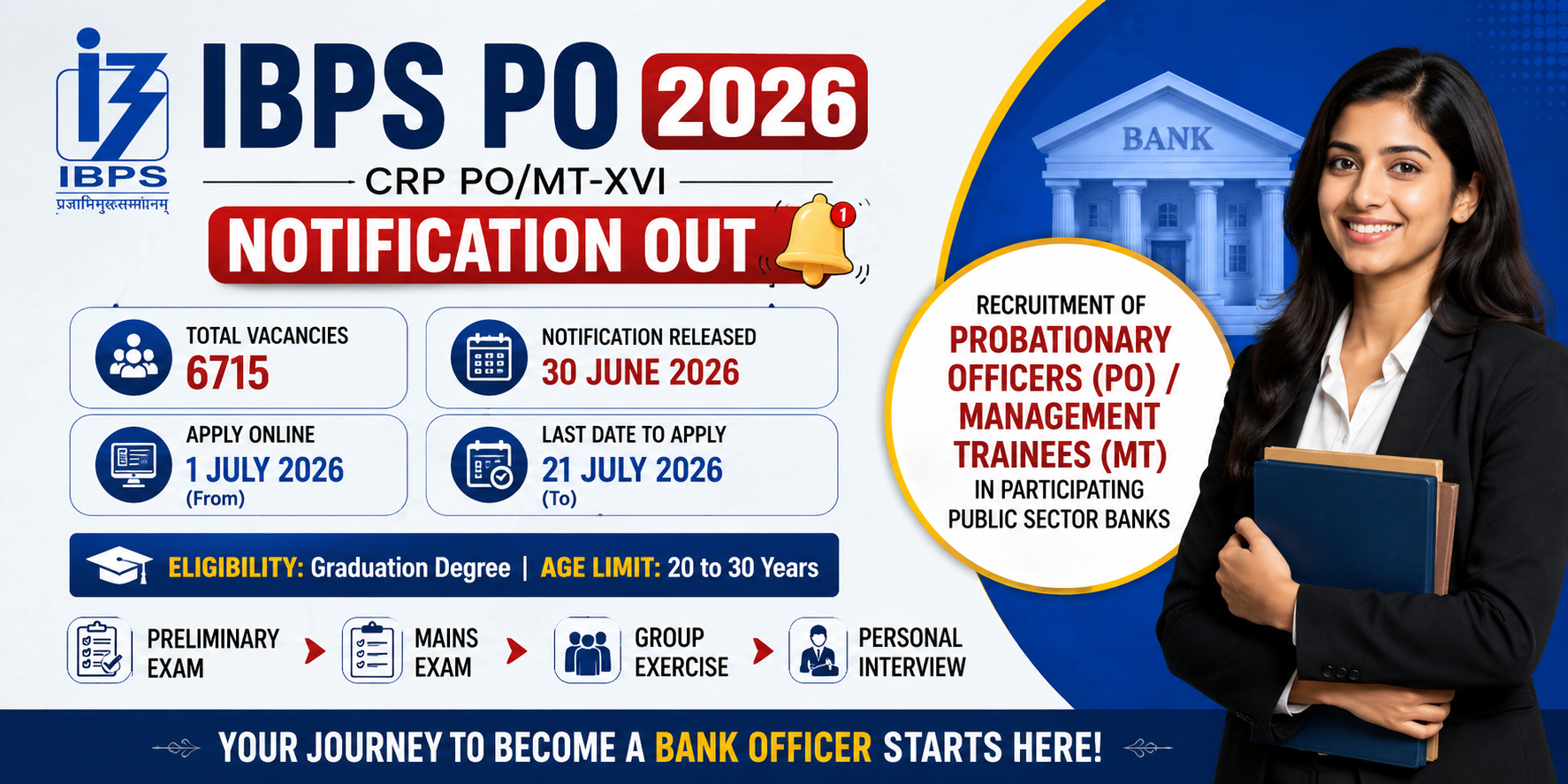
IBPS PO Syllabus 2026: Revised Prelims and Mains Exam Pattern, Descriptive Paper and Interview
Last Updated: 26 August 2026
The IBPS PO Syllabus 2026 and exam pattern have been revised for the Common Recruitment Process for Probationary Officers and Management Trainees, CRP PO/MT-XVI. Candidates preparing for the examination must understand the latest section-wise distribution of questions, marks, sectional timings and selection stages before planning their preparation.
Under the revised pattern, IBPS PO Prelims continues to have 100 questions carrying 100 marks, but Reasoning Ability now carries 40 marks and Quantitative Aptitude carries 30 marks. The Mains Objective Test has been expanded to 170 questions, while the Descriptive Paper now consists of Essay and Comprehension.
This article provides the complete IBPS PO Prelims syllabus, Mains syllabus, Descriptive Paper syllabus, Personality Test details and Interview syllabus based on the official IBPS PO/MT-XVI notification.
Important note: IBPS officially specifies the names of the tests, number of questions, marks and duration. It does not publish an exhaustive chapter-wise syllabus. The detailed topics listed below are based on the official sections and recurring question types observed in recent IBPS PO examinations.
IBPS PO Syllabus 2026: Overview
Particular | Details |
|---|---|
Examination | IBPS Probationary Officer/Management Trainee Examination 2026 |
Recruitment Cycle | CRP PO/MT-XVI |
Conducting Authority | Institute of Banking Personnel Selection |
Post | Probationary Officer/Management Trainee |
Examination Mode | Online |
Selection Process | Prelims, Mains, Personality Test and Interview |
Prelims Questions | 100 |
Prelims Marks | 100 |
Prelims Duration | 60 minutes |
Mains Objective Questions | 170 |
Mains Objective Marks | 200 |
Descriptive Questions | 2 |
Descriptive Marks | 25 |
Total Mains Marks | 225 |
Interview Marks | 100 |
Negative Marking | One-fourth of the marks assigned to the question |
Official Website |
IBPS PO Selection Process 2026
The IBPS PO 2026 selection process consists of the following stages:
- Online Preliminary Examination
- Online Main Examination
- Personality Test
- Common Interview
- Provisional Allotment
The Preliminary Examination is qualifying in nature. Prelims marks are not included in the final merit list. Candidates must qualify in the Mains Examination to become eligible for the Personality Test and Common Interview.
The final merit list is prepared using the marks obtained in the Mains Examination and Interview in an 80:20 ratio.
IBPS PO Prelims Exam Pattern 2026
Under the revised IBPS PO Prelims Exam Pattern 2026, Reasoning Ability carries 40 marks, while Quantitative Aptitude carries 30 marks. The English Language section continues to carry 30 marks.
- The examination contains three separately timed sections.
- Each section has a duration of 20 minutes.
- Candidates cannot switch between sections during the allotted sectional time.
- Candidates must qualify in each section according to the cut-offs prescribed by IBPS.
- For every incorrect answer, one-fourth of the marks assigned to that question will be deducted.
- No penalty will be imposed for unanswered questions.
Sr. No. | Name of Test | Questions | Maximum Marks | Medium | Duration |
|---|---|---|---|---|---|
1 | English Language | 30 | 30 | English | 20 minutes |
2 | Quantitative Aptitude | 35 | 30 | English and Hindi | 20 minutes |
3 | Reasoning Ability | 35 | 40 | English and Hindi | 20 minutes |
Total | Preliminary Examination | 100 | 100 | — | 60 minutes |
IBPS PO Prelims Syllabus 2026
English Language Syllabus for Prelims
The English Language section assesses a candidate’s reading ability, vocabulary, grammar and understanding of sentence structure.
Topic | Areas to Prepare |
|---|---|
Reading Comprehension | Main idea, factual questions, inference, tone, vocabulary, title and conclusion |
Cloze Test | Vocabulary-based, grammar-based and contextual fillers |
Error Detection | Subject-verb agreement, tense, article, preposition, pronoun, conjunction and modifier errors |
Sentence Improvement | Grammar correction, contextual replacement and phrase correction |
Fill in the Blanks | Single fillers, double fillers and multiple fillers |
Para Jumbles | Sentence arrangement and paragraph sequencing |
Sentence Rearrangement | Logical arrangement of sentences and connectors |
Phrase Replacement | Correct phrase selection and grammatical improvement |
Word Swap | Interchanging incorrectly placed words |
Vocabulary | Synonyms, antonyms, contextual meanings and word usage |
Spelling Errors | Correct spelling and identification of misspelled words |
Sentence Connectors | Combining sentences using suitable connectors |
Odd Sentence | Identifying the sentence that does not fit the paragraph |
Match the Columns | Matching sentence fragments to form meaningful statements |
Important English Topics for Prelims
Reading Comprehension, Cloze Test, Error Detection, Fillers, Para Jumbles, Phrase Replacement and Word Swap should receive the highest priority.
Quantitative Aptitude Syllabus for Prelims
The Quantitative Aptitude section evaluates calculation speed, numerical ability and the application of mathematical concepts.
Topic | Areas to Prepare |
|---|---|
Simplification | BODMAS, fractions, decimals, percentages, square roots and basic calculations |
Approximation | Estimation, percentage approximation and decimal approximation |
Number Series | Missing number series, wrong number series and pattern-based series |
Quadratic Equations | Factorisation, roots and comparison of variables |
Data Interpretation | Tables, bar graphs, line graphs, pie charts and caselet DI |
Percentage | Percentage increase, decrease and comparative percentage |
Ratio and Proportion | Direct ratio, inverse ratio, partnership and distribution |
Average | Simple average, weighted average and combined average |
Profit and Loss | Cost price, selling price, discount, marked price and successive discounts |
Simple Interest | Principal, rate, time and amount |
Compound Interest | Annual, half-yearly and comparative interest calculations |
Time and Work | Work efficiency, combined work and wages |
Pipes and Cisterns | Filling, emptying and net work rate |
Time, Speed and Distance | Average speed, relative speed and basic movement problems |
Trains | Platform, pole, crossing and relative speed |
Boats and Streams | Upstream speed, downstream speed and still-water speed |
Mixture and Alligation | Ratio of mixtures, replacement and weighted price |
Partnership | Capital ratio, time period and profit distribution |
Ages | Present, past and future age relationships |
Mensuration | Area, perimeter, volume and surface area |
Probability | Basic event-based probability |
Permutation and Combination | Fundamental counting-based questions |
Quantity Comparison | Comparing two mathematical quantities |
Important Quantitative Aptitude Topics for Prelims
Data Interpretation, Simplification, Approximation, Number Series, Quadratic Equations, Percentage, Ratio, Average, Profit and Loss, Time and Work, and Time-Speed-Distance are generally the most important areas.
Reasoning Ability Syllabus for Prelims
Reasoning Ability carries 40 marks under the revised Prelims pattern, making accuracy in this section particularly important.
Topic | Areas to Prepare |
|---|---|
Seating Arrangement | Linear, circular, square and rectangular arrangements |
Puzzles | Floor, box, scheduling, month, date, comparison and designation-based puzzles |
Syllogism | Conclusions, possibility cases and coded syllogism |
Inequality | Direct, coded and statement-based inequality |
Coding-Decoding | Traditional coding, word coding and new-pattern coding |
Blood Relations | Direct, coded and puzzle-based family relationships |
Direction and Distance | Direction sense, displacement and shortest distance |
Order and Ranking | Position, rank, comparison and total-person calculations |
Alphanumeric Series | Letter, number and symbol-based arrangements |
Alphabet Test | Word formation, letter position and alphabetical arrangement |
Pair Formation | Meaningful and positional letter pairs |
Data Sufficiency | Determining whether the given statements are sufficient |
Input-Output | Basic arrangement and pattern-based operations |
Logical Sequence | Sequence, arrangement and relationship-based questions |
Miscellaneous Reasoning | Meaningful words, odd one out and number-letter relationships |
Important Reasoning Topics for Prelims
Puzzles and Seating Arrangements usually form a major part of the section. Candidates should also prioritise Syllogism, Inequality, Coding-Decoding, Blood Relations, Direction Sense, Ranking and Alphanumeric Series.
IBPS PO Mains Exam Pattern 2026
The IBPS PO Mains Examination consists of an Objective Test and a Descriptive Paper. The revised Objective Test contains 170 questions carrying 200 marks. The Descriptive Paper contains two questions carrying 25 marks.
Important Changes in the Revised Mains Pattern
- The total number of objective questions has increased from 145 to 170.
- Reasoning contains 40 questions carrying 60 marks.
- General, Economy, Banking, Digital and Financial Awareness contains 50 questions carrying 60 marks.
- RBI circulars have specifically been included in the Awareness section.
- English Language contains 40 questions carrying 20 marks.
- Data Analysis and Interpretation contains 40 questions carrying 60 marks.
- The Descriptive Paper now consists of Essay and Comprehension.
- Letter Writing is not mentioned in the revised 2026 Descriptive Paper pattern.
- The Objective Test carries 200 marks and has a duration of 160 minutes.
- The complete Mains Examination carries 225 marks and has a total duration of 190 minutes.
IBPS PO Mains Objective Exam Pattern
Sr. No. | Name of Test | Questions | Maximum Marks | Medium | Duration |
|---|---|---|---|---|---|
1 | Reasoning | 40 | 60 | English and Hindi | 45 minutes |
2 | General/Economy/Banking Awareness/Digital/Financial Awareness, including RBI Circulars | 50 | 60 | English and Hindi | 35 minutes |
3 | English Language | 40 | 20 | English | 35 minutes |
4 | Data Analysis and Interpretation | 40 | 60 | English and Hindi | 45 minutes |
Total | Objective Test | 170 | 200 | — | 160 minutes |
IBPS PO Descriptive Paper Pattern
Paper | Topics | Questions | Maximum Marks | Medium | Duration |
|---|---|---|---|---|---|
Descriptive Paper | Essay and Comprehension | 2 | 25 | English | 30 minutes |
Complete IBPS PO Mains Exam Structure
Examination Component | Questions | Maximum Marks | Duration |
|---|---|---|---|
Objective Test | 170 | 200 | 160 minutes |
Descriptive Paper | 2 | 25 | 30 minutes |
Total | 172 | 225 | 190 minutes |
IBPS PO Mains Syllabus 2026
Reasoning Syllabus for Mains
The Mains Reasoning section assesses advanced analytical reasoning, decision-making and the ability to solve complex arrangements.
Topic | Areas to Prepare |
|---|---|
Advanced Seating Arrangement | Circular, linear, square, rectangular, uncertain-number and multi-variable arrangements |
Advanced Puzzles | Floor-flat, scheduling, designation, box, category, comparison and distribution puzzles |
Coded Directions | Direction and distance questions using coded information |
Coded Blood Relations | Family-tree and relationship questions in coded form |
Input-Output | Number, word, symbol and multi-step machine input-output |
Data Sufficiency | Two-statement and three-statement data sufficiency |
Coding-Decoding | New-pattern coding, conditional coding and symbol coding |
Syllogism | Coded syllogism, reverse syllogism and possibility-based conclusions |
Inequality | Coded, direct and statement-based inequality |
Logical Reasoning | Statement and assumption, statement and conclusion, inference and argument |
Cause and Effect | Identification of logical cause-and-effect relationships |
Course of Action | Selecting the most appropriate action for a situation |
Statement and Argument | Strong and weak arguments |
Statement and Conclusion | Validity of conclusions based on statements |
Critical Reasoning | Strengthening, weakening, inference and assumption questions |
Decision-Making | Selecting logical decisions based on the given conditions |
Order and Ranking | Multi-variable rank and position-based questions |
Analytical Reasoning | Condition-based arrangements and deductions |
High-Priority Reasoning Topics for Mains
Advanced Puzzles, Seating Arrangements, Input-Output, Data Sufficiency, Critical Reasoning, Coded Reasoning and Logical Reasoning should be prioritised.
The official 2026 Mains structure names this section “Reasoning.” It does not list Computer Aptitude as a separate test.
General, Economy, Banking, Digital and Financial Awareness Syllabus
This section carries 60 marks and includes RBI circulars. Candidates should prepare current affairs along with conceptual banking and financial awareness.
Area | Important Topics |
|---|---|
Banking Awareness | Types of banks, banking structure, banking products, deposits, loans and advances |
Reserve Bank of India | Functions, monetary policy, policy rates, regulation and supervision |
RBI Circulars | Recent circulars, master directions, regulatory changes and customer-service guidelines |
Monetary Policy | Repo rate, SDF, MSF, CRR, SLR, liquidity and inflation management |
Financial Institutions | RBI, NABARD, SIDBI, SEBI, IRDAI, PFRDA, EXIM Bank and NHB |
Banking Regulation | Banking Regulation Act, RBI Act and major regulatory provisions |
Financial Awareness | Financial markets, money market, capital market, bonds, securities and mutual funds |
Economy | GDP, inflation, unemployment, fiscal deficit, balance of payments and economic growth |
Government Schemes | Financial inclusion, insurance, pension, employment and welfare schemes |
Union Budget | Major allocations, fiscal targets, tax announcements and banking-related measures |
Economic Survey | Economic indicators, growth projections and sector-wise findings |
Digital Banking | Internet banking, mobile banking, digital lending and neo-banking |
Digital Payments | UPI, IMPS, NEFT, RTGS, AePS, BBPS, cards and digital wallets |
FinTech | Digital lending, account aggregators, regulatory sandbox and financial technology |
Banking Technology | Core banking, API banking, blockchain, artificial intelligence and cloud banking |
Cybersecurity | Phishing, malware, data protection, digital fraud and safe banking practices |
Non-Performing Assets | NPA classification, provisioning, recovery and stressed assets |
Basel Norms | Capital adequacy, risk management and Basel framework |
Priority-Sector Lending | Categories, targets and sub-targets |
Financial Inclusion | Jan Dhan Yojana, Business Correspondents, small finance banks and payment banks |
International Organisations | IMF, World Bank, ADB, AIIB, WTO and important international reports |
Current Affairs | National, international, banking, economy, appointments, awards and reports |
Static Banking Awareness | Bank headquarters, taglines, mergers and important banking terminology |
Current-Affairs Preparation Period
Candidates should thoroughly prepare at least the six months preceding the Mains Examination. Special attention should be given to banking news, RBI notifications, monetary policy, government schemes, financial appointments, reports, indices and the Union Budget.
English Language Syllabus for Mains
The Mains English section contains 40 questions carrying 20 marks. Although the marks are lower than before, the section requires advanced reading comprehension and contextual understanding.
Topic | Areas to Prepare |
|---|---|
Reading Comprehension | Banking, economy, technology, society and editorial-based passages |
Inference Questions | Implied meaning and conclusions based on the passage |
Tone and Theme | Author’s tone, central idea, purpose and suitable title |
Vocabulary in Context | Synonyms, antonyms and contextual meanings |
Cloze Test | Advanced vocabulary, grammar and contextual completion |
Error Detection | Grammar, syntax and contextual errors |
Sentence Improvement | Phrase replacement and grammatical correction |
Para Jumbles | Logical sequencing of sentences |
Sentence Rearrangement | Arrangement of complex statements |
Paragraph Completion | Selecting the most suitable concluding or connecting sentence |
Para Summary | Identifying the best summary of a paragraph |
Fillers | Single, double and multiple fillers |
Word Swap | Correct placement of words within sentences |
Connectors | Combining statements using logical connectors |
Column Matching | Matching phrases and sentence parts |
Odd Sentence | Identifying the sentence unrelated to the paragraph |
Sentence Usage | Correct use of words in different sentences |
Grammar | Tenses, subject-verb agreement, modifiers, articles, prepositions and conjunctions |
High-Priority English Topics for Mains
Reading Comprehension, Inference, Vocabulary in Context, Para Jumbles, Paragraph Completion, Cloze Test, Error Detection and Sentence Connectors should receive maximum attention.
Data Analysis and Interpretation Syllabus
The Data Analysis and Interpretation section carries 60 marks and requires strong arithmetic knowledge, calculation speed and analytical ability.
Topic | Areas to Prepare |
|---|---|
Tabular Data Interpretation | Data presented in rows and columns |
Bar Graph | Simple, multiple and stacked bar graphs |
Line Graph | Single and multiple line graphs |
Pie Chart | Percentage, angle and value-based pie charts |
Caselet DI | Paragraph-based data sets |
Missing DI | Finding missing values before solving the set |
Mixed Graph DI | Combined table, line, bar and pie-chart sets |
Radar Graph | Comparison of multiple variables |
Data Sufficiency | Quantity-based two-statement and three-statement questions |
Quantity Comparison | Comparing Quantity I and Quantity II |
Number Series | Missing and incorrect number patterns |
Quadratic Equations | Roots and comparison of variables |
Data Probability | Probability-based data sets |
Data Permutation | Arrangement and selection-based data sets |
Percentage | Increase, decrease and comparative percentage |
Ratio and Proportion | Distribution, partnership and comparative ratios |
Average | Combined and weighted averages |
Profit, Loss and Discount | Cost, selling price, marked price and discount |
Time and Work | Efficiency, wages and combined work |
Pipes and Cisterns | Inlet, outlet and net efficiency |
Time, Speed and Distance | Relative speed and average speed |
Boats, Streams and Trains | Motion-based applications |
Mixture and Alligation | Replacement, concentration and weighted values |
Simple and Compound Interest | Interest, instalments and comparative returns |
Mensuration | Area, volume and surface-area applications |
Probability | Events, selection and conditional probability |
Permutation and Combination | Arrangement and selection |
Partnership | Investment, duration and profit-sharing |
Ages | Present, past and future age-based questions |
High-Priority Data Analysis Topics
Candidates should prioritise Caselet DI, Missing DI, Mixed Graphs, Table DI, Bar and Line Graphs, Data Sufficiency, Quantity Comparison and arithmetic-based data sets.
IBPS PO Descriptive Paper Syllabus 2026
The revised IBPS PO Descriptive Paper consists of Essay and Comprehension. It contains two questions carrying 25 marks and must be completed in 30 minutes.
Component | Skills Assessed |
|---|---|
Essay Writing | Organisation of ideas, relevance, grammar, vocabulary, coherence and factual accuracy |
Comprehension | Understanding, interpretation, summarisation and accurate written responses |
Expected Essay Topics
Essay topics may be based on:
- Indian economy and economic development
- Banking-sector reforms
- Financial inclusion
- Digital banking and digital payments
- Cybersecurity and online banking fraud
- Artificial intelligence in banking
- Role of RBI in the Indian economy
- Inflation and monetary policy
- Financial literacy
- Women’s participation in the economy
- Climate change and green banking
- Education and employment
- Social media and society
- Data privacy
- Ethics in banking
- Emerging financial technologies
- Government financial schemes
- Current national and international developments
Comprehension Preparation Areas
Candidates may be required to read a passage and answer questions using clear and grammatically correct English. Preparation should focus on:
- Identifying the central idea
- Understanding factual information
- Drawing logical inferences
- Explaining words or phrases in context
- Summarising the passage
- Writing concise answers
- Maintaining correct grammar and sentence structure
Descriptive Paper Preparation Tips
- Practise typing essays within a fixed time limit.
- Follow a clear introduction-body-conclusion structure.
- Avoid excessively long sentences.
- Use relevant facts without introducing doubtful statistics.
- Maintain a formal and balanced tone.
- Practise comprehension passages from banking, economy and current-affairs topics.
- Review grammar, spelling and sentence construction regularly.
IBPS PO Personality Test 2026
Candidates shortlisted after the Mains Examination are required to participate in a Personality Test before appearing for the Common Interview.
The Personality Test is a self-report assessment designed to identify behavioural preferences, personality traits and professional tendencies. It is not a conventional knowledge-based examination and does not have a fixed academic syllabus.
Particular | Details |
|---|---|
Nature | Self-report personality assessment |
Qualifying Status | Non-qualifying |
Academic Syllabus | No fixed syllabus |
Purpose | To assess behavioural traits and personality preferences |
Use of Profile | The personality profile may be placed before the Interview Panel |
Recommended Approach | Answer honestly, naturally and consistently |
How to Approach the Personality Test
- Read every statement carefully.
- Answer according to your actual behaviour.
- Avoid trying to present an unrealistically perfect personality.
- Maintain consistency across similar statements.
- Do not spend excessive time analysing every response.
- Demonstrate natural qualities such as responsibility, adaptability, integrity, teamwork and emotional stability.
IBPS PO Interview Pattern 2026
Candidates who qualify in the Mains Examination and complete the Personality Test are called for the Common Interview.
Particular | Details |
|---|---|
Maximum Marks | 100 |
Minimum Qualifying Marks for General and EWS | 40% |
Minimum Qualifying Marks for SC, ST, OBC and PwBD | 35% |
Final Weightage of Mains | 80% |
Final Weightage of Interview | 20% |
Conducting Authorities | Participating banks coordinated by IBPS |
Final Selection | Based on combined Mains and Interview scores |
Qualifying only in the Interview does not guarantee selection. Candidates must secure sufficiently high combined scores in the Mains Examination and Interview.
IBPS PO Interview Syllabus 2026
IBPS does not prescribe a fixed chapter-wise syllabus for the Interview. The panel may assess a candidate’s banking knowledge, communication ability, confidence, awareness, personality, decision-making and suitability for the role of a Probationary Officer.
Interview Area | Topics to Prepare |
|---|---|
Personal Introduction | Name, family, hometown, strengths, achievements and interests |
Educational Background | Graduation subjects, academic projects and application of the degree |
Work Experience | Job responsibilities, achievements, career change and professional challenges |
Banking Awareness | Banking products, types of accounts, loans, deposits and banking operations |
RBI and Monetary Policy | RBI functions, repo rate, SDF, MSF, CRR, SLR and inflation |
Economy | GDP, fiscal deficit, inflation, unemployment, Budget and Economic Survey |
Current Affairs | Important national, international, banking and economic developments |
Digital Banking | UPI, NEFT, RTGS, IMPS, fintech, digital lending and cybersecurity |
Government Schemes | Financial inclusion, insurance, pension and employment schemes |
Situational Questions | Customer complaints, team conflicts, pressure and ethical dilemmas |
Banking Career | Why banking, why IBPS PO and responsibilities of a Probationary Officer |
Organisation Knowledge | Participating banks, public-sector banking and recent banking developments |
Local Awareness | Important facts about the candidate’s state, district and hometown |
Communication Skills | Clarity, confidence, listening ability and professional behaviour |
Personality Assessment | Leadership, integrity, teamwork, adaptability and decision-making |
Common IBPS PO Interview Questions
- Tell us about yourself.
- Why do you want to join the banking sector?
- Why do you want to become a Probationary Officer?
- What are the responsibilities of a Bank PO?
- What are the major functions of the Reserve Bank of India?
- What is the difference between CRR and SLR?
- What is the repo rate, and how does it affect inflation?
- What is an NPA?
- What is priority-sector lending?
- What is financial inclusion?
- What is the difference between NEFT, RTGS, IMPS and UPI?
- What are the major challenges facing Indian banks?
- What is digital lending?
- How can banks prevent cyber fraud?
- What are your strengths and weaknesses?
- Why should the bank select you?
- Are you willing to work in a rural area?
- How would you handle an angry customer?
- How would you manage pressure and multiple responsibilities?
- What would you do if a senior asked you to perform an unethical task?
IBPS PO Negative-Marking Rules
Negative marking applies to the objective questions in both the Preliminary and Main examinations.
Response | Marking Rule |
|---|---|
Correct Answer | Marks assigned to the question are awarded |
Incorrect Answer | One-fourth of the marks assigned to the question are deducted |
Unanswered Question | No penalty |
Descriptive Paper | Objective-test negative marking does not apply |
Candidates should not describe the penalty as a flat deduction of 0.25 marks for every question. The correct official wording is “one-fourth of the marks assigned to that question,” because the marks per question may differ across sections.
IBPS PO Cut-Off Rules
IBPS may apply sectional and overall cut-offs at different stages of the recruitment process.
Prelims Cut-Off
Candidates must qualify in each of the three Prelims sections by securing the minimum cut-off prescribed by IBPS. They must also obtain the required overall score to be shortlisted for Mains.
Mains Cut-Off
Candidates must secure the minimum required score in each Mains test and the overall Mains Examination. The number of candidates shortlisted for the Interview depends on vacancies, category and performance.
Interview Qualifying Marks
- General and EWS: Minimum 40%
- SC, ST, OBC and PwBD: Minimum 35%
Final Merit List
The final combined score is calculated using:
- Mains Examination: 80% weightage
- Interview: 20% weightage
Prelims marks are not included in the final merit calculation.
Prelims and Mains: Key Differences
Particular | Prelims | Mains |
|---|---|---|
Purpose | Screening stage | Merit-deciding written stage |
Sections | 3 | 4 Objective Sections plus Descriptive Paper |
Objective Questions | 100 | 170 |
Descriptive Questions | Not applicable | 2 |
Maximum Marks | 100 | 225, including Descriptive |
Duration | 60 minutes | 190 minutes, including Descriptive |
Difficulty Level | Moderate | Moderate to difficult |
Marks Used in Final Merit | No | Yes |
Negative Marking | Yes | Yes, for Objective Test |
Medium | English/Hindi as specified | English/Hindi as specified |
Subject-Wise Preparation Strategy
Section | Recommended Preparation Approach |
|---|---|
English Language | Read editorials, strengthen grammar and practise comprehension daily |
Quantitative Aptitude | Improve calculation speed and master arithmetic fundamentals |
Reasoning | Practise puzzles and seating arrangements with timed sets |
Data Analysis and Interpretation | Solve mixed DI sets and revise arithmetic concepts |
Banking and Financial Awareness | Study daily current affairs, RBI circulars and monthly banking updates |
Descriptive English | Type one essay or comprehension exercise regularly |
Interview | Prepare personal, banking, economic and situational questions |
Preparation Strategy for Prelims
- Build accuracy before attempting to increase speed.
- Practise each section within the official 20-minute time limit.
- Memorise multiplication tables, squares, cubes, fractions and percentage conversions.
- Solve at least two puzzle or seating-arrangement sets daily.
- Read English editorials and note new vocabulary.
- Take full-length mock tests and analyse every incorrect answer.
- Develop a section-wise attempt strategy based on personal strengths.
Preparation Strategy for Mains
- Begin Mains preparation before the Prelims result.
- Practise difficult puzzles and analytical reasoning.
- Solve high-level DI sets under time pressure.
- Study banking and financial current affairs every day.
- Regularly revise RBI circulars and monetary-policy announcements.
- Practise long Reading Comprehension passages.
- Type essays and comprehension answers in a timed environment.
- Attempt full-length Mains mock tests with sectional timings.
Preparation Strategy for Interview
- Prepare a concise and natural self-introduction.
- Review graduation subjects and professional experience.
- Understand the role and responsibilities of a Probationary Officer.
- Study current banking, financial and economic developments.
- Prepare facts about your hometown and state.
- Practise situational and ethical questions.
- Maintain professional body language and answer honestly.
- Avoid guessing when you do not know an answer.
Conclusion
The revised IBPS PO Syllabus and Exam Pattern 2026 requires candidates to prepare strategically for both speed-based and knowledge-based sections. Reasoning now has greater weightage in Prelims, while the expanded Mains pattern gives significant importance to Banking and Financial Awareness, RBI circulars, Data Analysis and Interpretation, and advanced reasoning.
Candidates should first understand the section-wise structure, create a realistic study plan, practise with sectional and full-length mock tests, and begin Mains preparation well before the Prelims result. Consistent practice, current-affairs revision, descriptive-writing improvement and structured Interview preparation will be essential for success in IBPS PO 2026.
Official Reference: IBPS CRP PO/MT-XVI