
IBPS Clerk Syllabus 2026
IBPS Clerk Syllabus 2026 – Complete Prelims & Mains Exam Pattern & Topics
Check IBPS Clerk 2026 syllabus with Prelims and Mains exam pattern, section-wise topics, marking scheme and official updates.
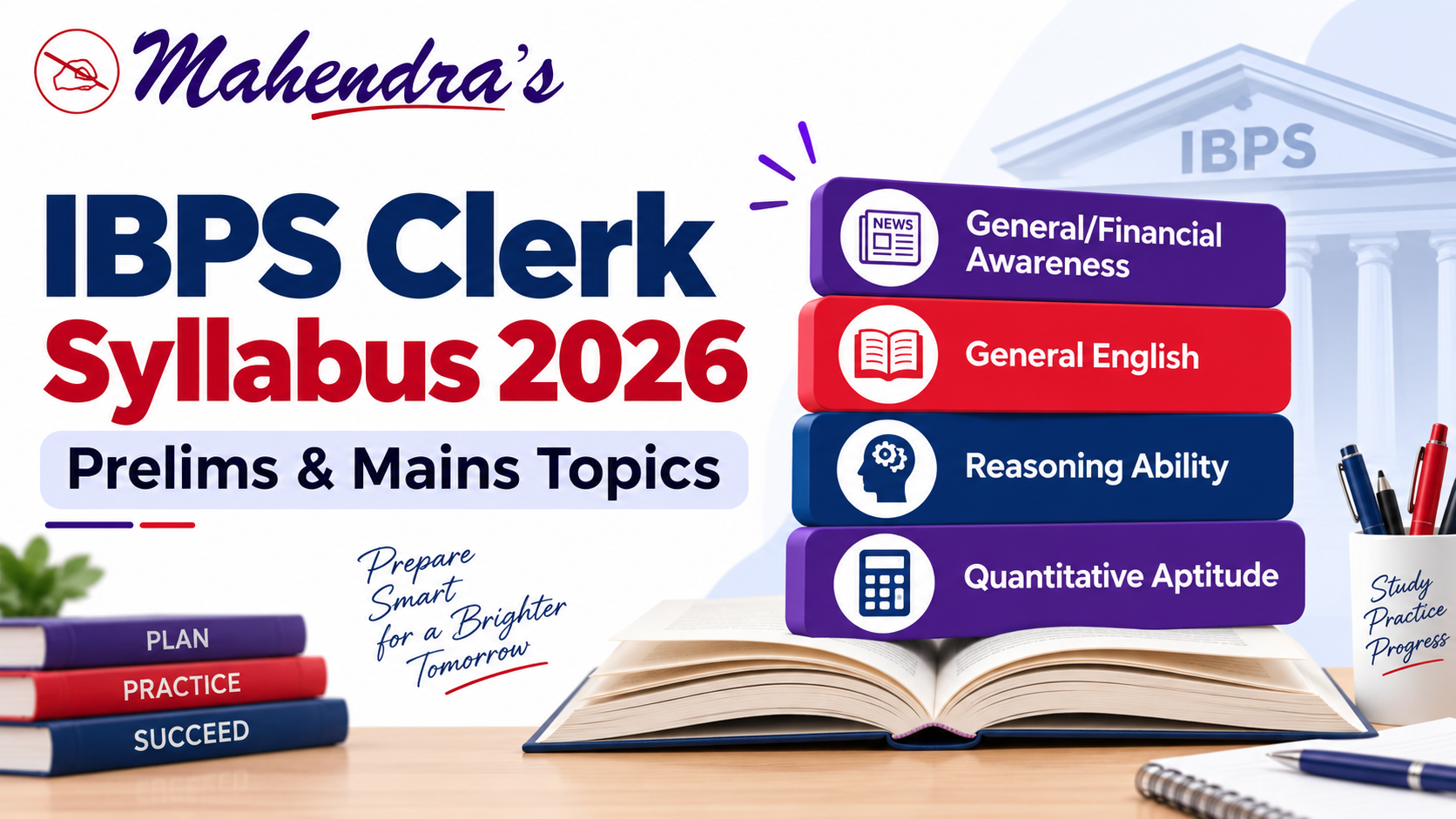
IBPS Clerk Syllabus 2026: Detailed Prelims and Mains Guide
Prepare for IBPS Clerk (Customer Service Associate) through a clear sequence: understand the examination sections, master each topic and then practise timed mixed tests. This guide explains what to study and how to approach each area, instead of presenting only a list of chapter names.
Scope: The examination structure follows CRP CSA-XVI. The chapter lists and study suggestions below are preparation guidance; they are not an official guarantee of topic-wise questions or weightage. Check the current IBPS notification and any later corrigendum before relying on examination rules.
Prelims and Mains: How the Syllabus Differs
Stage | Sections | Preparation focus |
|---|---|---|
Prelims | English Language; Numerical Ability; Reasoning Ability | Build fundamentals, speed, accuracy and selection of manageable questions within each section. |
Mains | General/Financial Awareness; General English; Reasoning Ability; Quantitative Aptitude | Add financial awareness, deeper reading, complex reasoning and multi-step data interpretation. |
The current Mains structure has no separately named Computer Aptitude section. Computer literacy as an eligibility requirement is a different matter; consult the eligibility page for that requirement.
Prelims Exam Structure
Section | Questions / marks | Time |
|---|---|---|
English Language | 30 / 30 | 20 minutes |
Numerical Ability | 35 / 35 | 20 minutes |
Reasoning Ability | 35 / 35 | 20 minutes |
Total | 100 / 100 | 60 minutes |
Sections are separately timed. Practise within each section limit; unused time should not be treated as transferable. Prelims shortlists candidates for Mains, so preparation must cover every section rather than depend on a strong overall score alone.
English Language: Prelims
Learn how meaning, grammar and vocabulary work together. Reading speed helps only when you can identify the evidence for an answer. Build sentence accuracy first, then practise mixed questions under a timer.
Topic group | What to study | Concept and practice approach |
|---|---|---|
Reading comprehension | Main idea, factual details, inference, tone, vocabulary in context and suitable titles. | Read the question, locate supporting lines and eliminate choices that add information absent from the passage. |
Grammar and error detection | Subject–verb agreement, tense, articles, pronouns, prepositions, modifiers, parallelism and conjunctions. | Identify the subject and verb before judging a sentence. Explain the rule behind every correction in your error notebook. |
Fillers and cloze test | Single and double fillers; grammar-based and contextual blanks; connectors and collocations. | Read the whole sentence or paragraph. A word must fit both grammar and meaning, not just sound familiar. |
Sentence improvement and phrase replacement | Incorrect phrases, tense consistency, idiomatic use and concise construction. | Compare the complete meaning of each option. Re-read the corrected sentence before choosing it. |
Para jumbles and rearrangement | Opening and concluding statements, reference words, chronology and logical pairs. | Find sentences that must stay together, then use pronouns and connectors to determine sequence. |
Vocabulary and word usage | Synonyms, antonyms, contextual meanings, word swap and common idioms. | Learn a word through an example and a common collocation. Revise confusing pairs rather than isolated definitions. |
Numerical Ability: Prelims
Percentages, ratios and averages are the foundation of arithmetic and data interpretation. Learn to translate a sentence into a mathematical relation before trying a shortcut.
Topic group | What to study | Concept and practice approach |
|---|---|---|
Calculation skills | Simplification, approximation, fractions, decimals, squares, cubes and BODMAS. | Use exact calculation where options are close. Approximate only when the problem and answer spacing permit it. |
Number series and equations | Missing/wrong number patterns and quadratic equations. | Check differences, ratios and alternating patterns. For equations, compare every possible root rather than only positive roots. |
Percentages, ratio and averages | Percentage change, proportion, weighted average and comparison. | Keep the base value clear: a 20% rise followed by a 20% fall does not restore the original value. |
Commercial arithmetic | Profit/loss, discount, simple/compound interest and partnership. | Distinguish cost price, selling price and marked price. In partnership, compare capital multiplied by investment time. |
Work and speed | Time/work, efficiency, pipes/cisterns, distance, trains and boats/streams. | Convert quantities to consistent units. For combined work, add rates; for relative speed, identify the direction of travel. |
Mixtures, ages and mensuration | Mixture and alligation, replacement, age relationships, perimeter, area and volume. | Write the governing relationship first. Check whether the question asks a linear, square or cubic measure. |
Data interpretation | Tables, bars, lines, pie charts and short caselets. | Read units, scale and totals before calculation. Practise percentage comparison, ratio and average questions from the same dataset. |
Reasoning Ability: Prelims
Reasoning rewards organised deductions. Write a clean diagram, distinguish confirmed facts from possibilities and avoid carrying an assumption into the final answer.
Topic group | What to study | Concept and practice approach |
|---|---|---|
Puzzles and seating | Linear/circular seating, floors, boxes, scheduling, ordering and simple distribution. | Choose the most restrictive clue first. Track each valid possibility separately and reject a case only when a clue contradicts it. |
Syllogism | All/some/no statements and conclusions. | Use Venn diagrams and check whether a conclusion must follow. Do not import real-world knowledge into the statements. |
Inequality | Direct and coded comparison chains. | Combine compatible relations and test each conclusion independently; an unknown relation is not automatically false. |
Coding-decoding and series | Letter/number coding, alphanumeric sequences and pattern relationships. | Identify whether the rule concerns position, order or substitution. Validate the rule on more than one example. |
Blood relations and directions | Family trees, coded relations, movement and distance. | Mark gender only when stated. Fix a north direction and trace each movement in sequence. |
Order/ranking and word questions | Positions from either end, arrangement of letters, pair formation and word formation. | Account for overlapping positions and avoid counting the same person or pair twice. |
General English: Mains
Mains preparation should develop deeper comprehension and closer comparison of answer choices. A grammatically correct choice may still be wrong because it changes the author's argument.
Topic group | What to study | Concept and practice approach |
|---|---|---|
Longer reading and inference | Main argument, implied meaning, tone, purpose, conclusions and vocabulary. | Separate what the passage states from what it reasonably implies. Reject overly broad or absolute answers without textual support. |
Paragraph coherence | Rearrangement, connectors, sentence insertion and paragraph completion. | Follow the argument from claim to evidence and conclusion. Check references across sentences. |
Advanced language application | Error correction, phrase replacement, contextual fillers, word usage and cloze formats. | Practise mixed sets so that you identify the task before applying a grammar rule. Review both the correct answer and the distractors. |
Quantitative Aptitude: Mains
Use the same arithmetic foundations at a higher level of interpretation. Mains practice should include multi-step problems where identifying the required information is as important as calculating it.
Topic group | What to study | Concept and practice approach |
|---|---|---|
Advanced data interpretation | Multi-chart sets, caselets, missing data and arithmetic-linked DI. | List known and unknown quantities before calculation. Do not assume missing values unless they can be derived. |
Applied arithmetic | Percentages, ratio, averages, interest, profit/loss, work, speed, mixtures and mensuration in combined problems. | Build equations from the conditions and check whether your answer satisfies all of them. |
Data sufficiency and quantity comparison | Sufficiency of individual/combined statements and comparison of two quantities. | Determine whether a unique answer exists. For comparisons, test all valid cases before selecting a relationship. |
Series, equations and calculation | Number series, quadratic equations, simplification and approximation. | Practise these alongside DI so that calculation fluency does not become the bottleneck. |
Prepare with Mahendras Bank Mahapack

Reasoning Ability: Mains
Increase the complexity gradually: first solve accurately without timing, then reduce solving time. Maintain a clear distinction between a definite conclusion and one possible arrangement.
Topic group | What to study | Concept and practice approach |
|---|---|---|
Complex puzzles and seating | Multi-variable distribution, scheduling and arrangements with several linked attributes. | Create a compact grid. Keep tentative cases separate and revisit clues after each confirmed placement. |
Input-output | Stepwise arrangements and transformations of words or numbers. | Infer the operation performed at each step and verify that it explains the complete sequence. |
Data sufficiency and coded reasoning | Information sufficiency, coded relations, advanced directions and inequalities. | Test statements separately before combining them. A plausible arrangement is not necessarily a unique solution. |
Critical reasoning | Assumptions, arguments, conclusions, cause/effect and courses of action. | Judge the stated argument rather than personal opinion. Distinguish an assumption required by the argument from extra useful information. |
General/Financial Awareness: Mains
Build this section continuously while preparing for Prelims. Current affairs becomes easier to retain when linked to banking concepts and revised repeatedly. No fixed number of months or topic-wise question count is guaranteed here.
Topic group | What to study | Concept and practice approach |
|---|---|---|
Banking fundamentals | RBI functions, commercial banks, deposits, loans, financial inclusion and banking terminology. | Connect a news item to the institution's role. Distinguish policy rates, reserve requirements and lending/deposit concepts. |
Economy and monetary policy | Inflation, monetary policy, growth indicators, fiscal policy and major economic developments. | Understand what an indicator measures before memorising its latest value; verify time-sensitive values against official releases. |
Payments and financial institutions | Digital payments, payment systems, regulators and major financial institutions. | Learn the purpose, operator/regulator and basic process of each system. Avoid confusing a platform with its governing institution. |
Government schemes and public finance | Relevant schemes, Union Budget and Economic Survey highlights. | Record the responsible ministry, objective, beneficiary group and important current update. |
Current affairs and static links | Appointments, reports/indices, awards, national/international events and associated static awareness. | Use a dated revision notebook. Verify report publishers, reference periods and names before memorising facts. |
Negative Marking and Accuracy
For a wrong answer, one-fourth of the marks assigned to that question is deducted. An unanswered question attracts no penalty. Do not assume that every Mains error costs exactly 0.25 marks: calculate the penalty from the marks assigned to that question. In practice, record attempted questions, correct answers and the reason for each mistake.
A Practical Syllabus Completion Plan
Phase | Daily work | Completion check |
|---|---|---|
Build concepts | Study one concept, work through examples and solve a small topic set. Include reading and awareness revision. | Explain the method without copying the solution; identify your recurring errors. |
Connect topics | Mix related arithmetic/reasoning topics and practise complete English sets. | Choose the right method when the question type is not announced beforehand. |
Practise under time limits | Take sectional tests and then full mocks following the current examination structure. | Review incorrect, skipped and slow questions; distinguish concept gaps from time-management errors. |
Revise and retest | Revisit formulas, vocabulary, awareness notes and previous mistakes. | Solve fresh questions on previously weak topics accurately before marking them complete. |
How to Analyse a Mock Test
Classify every missed question into a concept gap, misreading, calculation error, poor question selection or lack of time. Re-solve it without the answer key, then compare your method with the explanation. A higher attempt count is useful only when accuracy remains under control. Record topic-wise progress so that revision addresses actual weaknesses.
Common Preparation Mistakes
- Treating a coaching topic list as official, fixed weightage.
- Starting financial awareness only after Prelims.
- Memorising shortcuts without understanding when they apply.
- Taking mocks without reviewing skipped and incorrect questions.
- Studying many sources without a revision cycle.
Official Source and Related Guides
Read the Official IBPS Notification
Use the Important Links below for the detailed exam pattern, schedule and eligibility rules. The topic guidance above should be adjusted if IBPS publishes a revised notification.
Solved Examples: Turn a Topic List into Understanding
Arithmetic: Successive Percentage Changes
A value of 100 rises by 20% and then falls by 20%. After the rise it is 120; the decrease is 20% of 120, which is 24. The final value is 96, a net decrease of 4%. Equal percentage rises and falls do not cancel because the base changes. Practise by writing the starting value, the new base and the final comparison before trying a shortcut.
Reasoning: Distinguish a Fact from an Assumption
Given: all pens are tools, and some tools are blue. Can we conclude that some pens are blue? No. The blue tools may be outside the group of pens. Draw pens as a circle inside tools, then place the blue group where the statements allow it. A conclusion must follow in every valid arrangement, not just one drawing.
English: Find the True Subject
In “The list of items are ready”, the subject is the singular noun “list”, not the nearer plural noun “items”. The correction is “The list of items is ready”. When reviewing an agreement error, identify the main subject and verb first, then check whether the phrase between them changes the subject. Record the rule with your corrected example.
These are original practice illustrations of common skills, not claims about questions that will appear in the examination.
Topic-Progress Checklist and Review Log
Copy this table into a notebook or spreadsheet, or print this section. Mark a topic ready only after concept study, independent practice and a later revision check. The sample workload is adjustable; use your own accuracy and available study time.
Topic | Concept check | Independent practice | Timed review | Next action |
|---|---|---|---|---|
Percentages | Explain why successive changes use different bases. | Example: 15 mixed questions; note every wrong step. | Try a short timed set after reviewing errors. | Revisit base-value mistakes after 2 days. |
Syllogism | Separate what must be true from what may be true. | Example: 10 statement/conclusion problems with diagrams. | Track time and accuracy without guessing from one diagram. | Reattempt doubtful conclusions. |
Subject–verb agreement | Identify the main subject in each sentence. | Example: 10 corrections with a written rule. | Use a mixed grammar set to test transfer. | Revise recurring error patterns. |
Banking/current affairs | Understand the event and its banking relevance. | Make short notes from dated, reliable sources. | Use a revision quiz; check explanations for errors. | Update notes when an official figure or announcement changes. |
Example progress entry: Percentages — 12 correct out of 15 attempted = 80% accuracy. Two errors came from choosing the wrong base and one from calculation. Next session: revise base selection, reattempt those three problems and then attempt a fresh mixed set. A single good score does not replace revision or prove exam readiness.