Company Logo

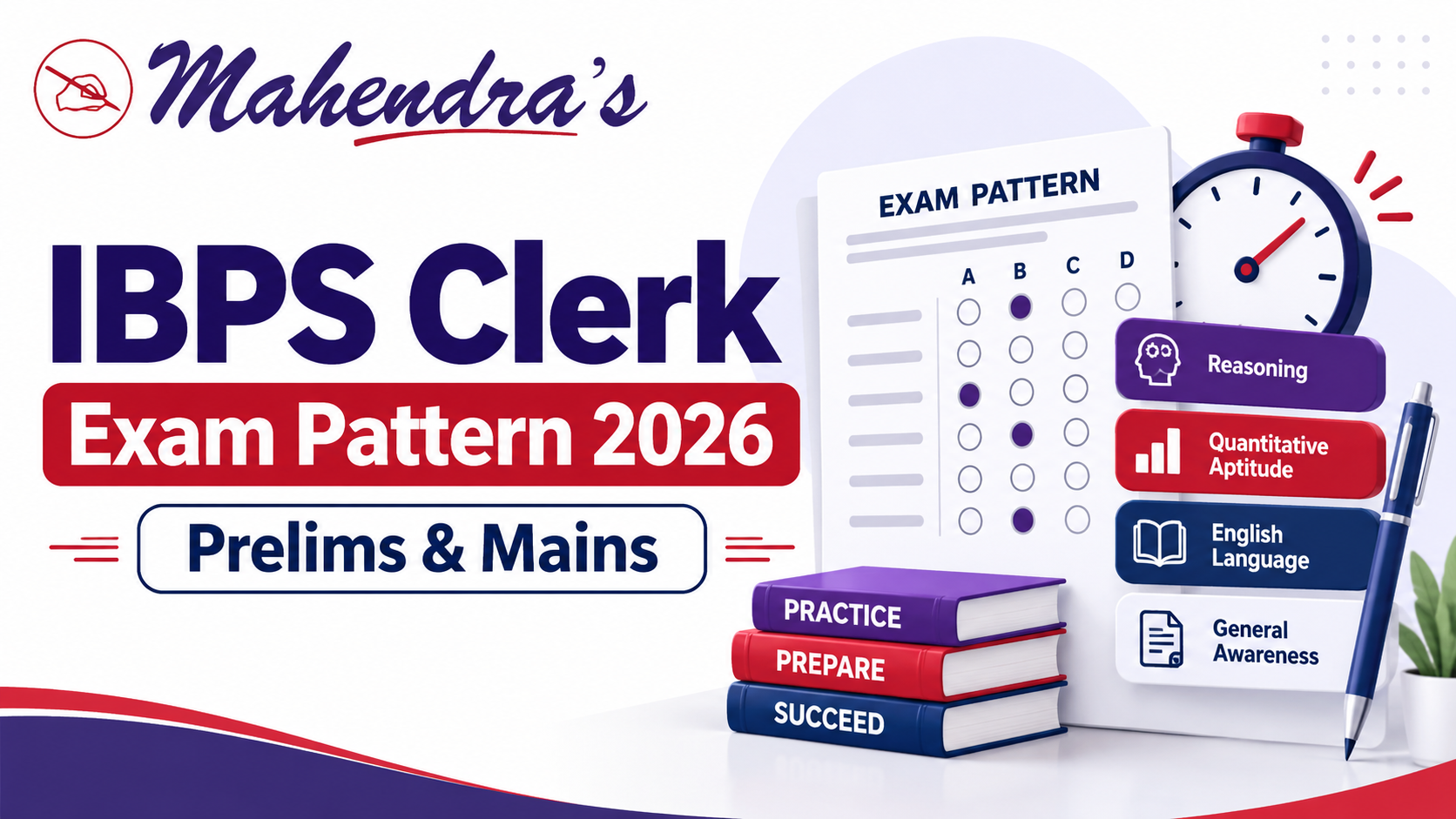
IBPS Clerk 2026 Exam Pattern

IBPS Clerk Exam Pattern 2026 – Prelims & Mains Section Wise Marks & Time

Check IBPS Clerk 2026 exam pattern with Prelims & Mains structure, section-wise marks, time duration, negative marking and selection process.
IBPS Clerk 2026 Exam Pattern

IBPS Clerk Exam Pattern 2026: Prelims, Mains, Marking Scheme and LLPT

The IBPS Clerk Exam Pattern 2026 consists of two online examinations: Preliminary and Main. Candidates who qualify in the Preliminary Examination are shortlisted for the Main Examination. After qualifying in Mains, candidates may also have to pass the Local Language Proficiency Test, unless they satisfy the exemption conditions.

The IBPS Clerk Prelims examination contains 100 questions carrying 100 marks, with a total duration of 60 minutes. The Main Examination contains 160 questions carrying 200 marks, to be completed in 125 minutes.

Both examinations have separately timed sections and a negative marking of 0.25 marks for every incorrect answer. Preliminary marks are used only for shortlisting, while Main Examination marks determine the final merit list and provisional allotment.

IBPS Clerk Notification 2026: OFFICIAL PDF DOWNLOAD LINK

IBPS Clerk Notification Detailed Video Information: Watch Here

IBPS Clerk Exam Pattern 2026: Overview

Particular

Preliminary Examination

Main Examination

Mode of examination

Online

Online

Type of questions

Objective MCQs

Objective MCQs

Number of sections

3

4

Total questions

100

160

Maximum marks

100

200

Total duration

60 minutes

125 minutes

Sectional timing

Yes

Yes

Negative marking

0.25 marks

0.25 marks

Sectional cut-off

Applicable

Applicable

Overall cut-off

Applicable

Applicable

Marks considered in final merit

No

Yes

IBPS Clerk Selection Stages 2026

The IBPS Clerk selection process is completed through the following stages:

  1. Online Preliminary Examination
  2. Online Main Examination
  3. Local Language Proficiency Test
  4. Document and eligibility verification
  5. Provisional allotment

There is no interview in the IBPS Clerk selection process.

Prelims is a qualifying and screening stage. Only the marks obtained in the Main Examination are considered for final merit listing and provisional allotment.

IBPS Clerk Preliminary Exam Pattern 2026

The Preliminary Examination consists of three sections:

  • English Language
  • Numerical Ability
  • Reasoning Ability

A total of 100 questions are asked for 100 marks. Candidates receive 20 minutes for each section, making the total examination duration 60 minutes.

Section

Questions

Maximum marks

Sectional time

English Language

30

30

20 minutes

Numerical Ability

35

35

20 minutes

Reasoning Ability

35

35

20 minutes

Total

100

100

60 minute

IBPS Clerk Main Exam Pattern 2026

The Main Examination contains four sections:

  • General/Financial Awareness
  • General English
  • Reasoning Ability
  • Quantitative Aptitude

The paper contains 160 questions carrying 200 marks. Candidates receive 125 minutes to complete the examination.

Section

Questions

Maximum marks

Sectional time

General/Financial Awareness

40

50

20 minutes

General English

40

40

35 minutes

Reasoning Ability

40

60

35 minutes

Quantitative Aptitude

40

50

35 minutes

Total

160

200

125 minutes

Important Features of the Mains Pattern

  • The Main Examination is conducted online.
  • It includes 160 objective questions carrying 200 marks.
  • Every section is separately timed.
  • The sections carry different maximum marks.
  • Reasoning Ability has the highest weightage of 60 marks.
  • Candidates must clear the sectional and overall qualifying scores.
  • Main Examination marks are considered for final merit listing.
  • State-wise and category-wise cut-offs apply.
  • A negative marking of one-fourth of the assigned marks applies.
  • Marks may be normalised when the examination is conducted in multiple sessions.


IBPS Clerk Negative Marking 2026

Negative marking applies to both the Preliminary and Main examinations.

For every incorrect answer, one-fourth or 0.25 of the marks assigned to that question will be deducted.

No marks will be deducted for a question that is left unanswered.

How Negative Marking Is Calculated

The exact penalty depends on the marks assigned to the question.

Marks assigned to question

Penalty for a wrong answer

1 mark

0.25 marks

1.25 marks

0.3125 marks

1.50 marks

0.375 marks

The notification defines the penalty as one-fourth of the marks assigned to that question. Therefore, candidates should not assume that every incorrect answer always carries an identical numerical deduction when sections have different mark-to-question ratios.

Negative-Marking Example

Suppose a candidate attempts 80 one-mark questions:

  • Correct answers: 65
  • Incorrect answers: 15
  • Marks for correct answers: 65
  • Negative marks: 15 × 0.25 = 3.75
  • Corrected score: 65 − 3.75 = 61.25 marks

This shows why random guessing can reduce the final score.

IBPS Clerk Sectional and Overall Cut-Off

Candidates must satisfy two types of cut-offs:

Sectional Cut-Off

A candidate must obtain the minimum qualifying marks in every section. Scoring high overall may not help if the candidate fails to clear one section.

Overall Cut-Off

Candidates must also obtain the overall qualifying score fixed for their State/UT and category.

Cut-offs can vary according to:

  • Number of State/UT-wise vacancies;
  • Category of the candidate;
  • Difficulty level of the examination;
  • Number of candidates appearing;
  • Overall candidate performance; and
  • Normalisation of scores across different shifts.

IBPS does not announce one universal cut-off for every State and category.

Score Normalisation

When the examination is conducted in multiple sessions, the corrected scores may be normalised using the equi-percentile method.

Normalisation helps balance differences in difficulty among different examination shifts. Scores are calculated up to two decimal places for the selection process.

How Final Merit Is Prepared

Preliminary marks are not considered for final selection. Only Main Examination marks are used for final merit listing.

The Main Examination carries 200 marks. For provisional allotment, these marks are converted to a score out of 100.

Converted Main Score=Marks Obtained in Mains200×100\text{Converted Main Score} = \frac{\text{Marks Obtained in Mains}}{200} \times 100Converted Main Score=200Marks Obtained in Mains​×100

For example, if a candidate scores 150 out of 200:

150200×100=75\frac{150}{200} \times 100 = 75200150​×100=75

The converted score would be 75 out of 100, subject to IBPS’s normalisation and calculation rules.

Final provisional allotment depends on:

  • Main Examination score;
  • State/UT-wise merit;
  • Candidate’s category;
  • Available vacancies;
  • Bank preferences;
  • Local-language eligibility;
  • Document verification; and
  • Other eligibility conditions.

Local Language Proficiency Test

The Local Language Proficiency Test, or LLPT, is a qualifying stage conducted after the Main Examination or provisional allotment but before joining the allotted bank.

Candidates applying for a particular State or Union Territory must be able to:

  • Read the selected local language;
  • Write the selected local language;
  • Speak the selected local language; and
  • Understand the selected local language.

Important LLPT Rules

  • Candidates must select one applicable local language while completing the application.
  • The selected language should be applicable to the State/UT for which the candidate applies.
  • LLPT is marks-based but qualifying in nature.
  • Its marks are not added to the final merit score.
  • The test may be conducted by an independent body or the allotted bank.
  • Candidates who fail the test will not be offered an appointment.
  • Passing Prelims and Mains does not remove the local-language requirement.

Who Is Exempted from the LLPT?

Candidates can be exempted if they produce a Class 10 or higher-level mark sheet or certificate proving that they studied the selected local language.

Candidate’s situation

LLPT status

Studied the selected language in Class 10 or above

Exemption may be granted

Did not study the selected language in Class 10 or above

LLPT required

Cannot produce valid academic proof

LLPT required

Passes LLPT

Eligible to proceed, subject to other conditions

Fails LLPT

Disqualified from appointment

Candidates should select their State and local language carefully while applying.

Languages and Medium of Examination

The English Language or General English test is available only in English. Other sections may be available in English, Hindi and applicable regional languages according to the State or Union Territory selected by the candidate.

Candidates should check the State-wise language table in the official notification before submitting the application.

Is There an Interview in IBPS Clerk 2026?

No interview is conducted for IBPS Clerk or Customer Service Associate recruitment.

The final merit list is based on the Main Examination score, subject to:

  • Clearing Prelims;
  • Clearing sectional and overall Main cut-offs;
  • Satisfying local-language requirements;
  • Verification of eligibility and documents; and
  • Availability of State/UT-wise vacancies.

Common Mistakes to Avoid

  • Preparing only for Prelims until the Prelims result;
  • Ignoring General and Financial Awareness;
  • Attempting lengthy puzzles before direct questions;
  • Guessing answers without eliminating options;
  • Focusing only on overall score and ignoring sectional cut-offs;
  • Practising without sectional time limits;
  • Choosing a State without checking its local-language requirement;
  • Assuming Prelims marks will improve final merit;
  • Neglecting mock-test analysis; and
  • Focusing on attempts instead of corrected score.

Important Links

Additional Links

FAQS

Enquire Now

Need Help with Your Preparation?

Fill out the form and our team will get in touch with you soon.